LINKS
Top articles and published information citing royaldutchshellplc.com website
Wikipedia article about royaldutchshellplc.com
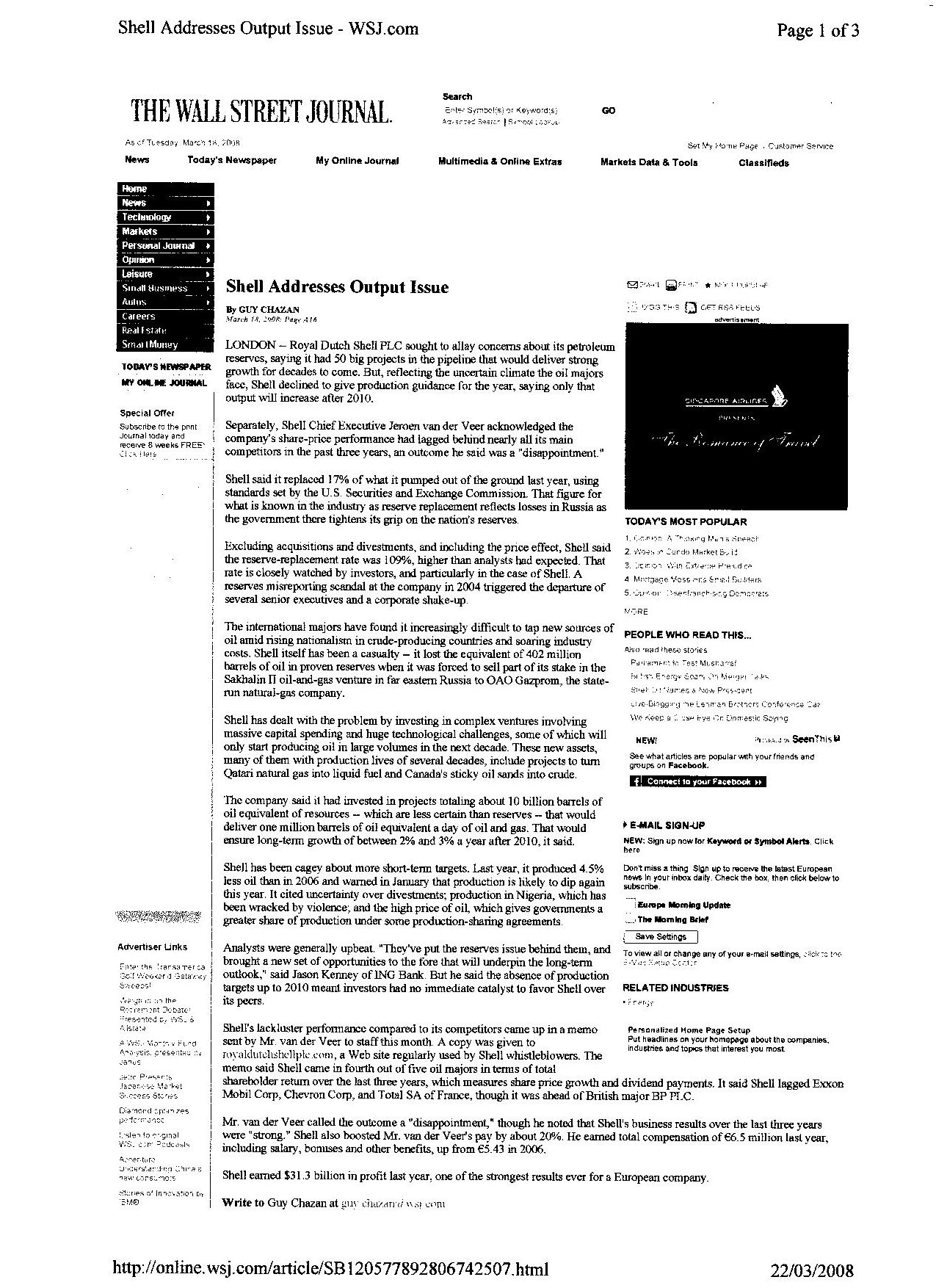
THE WALL STREET JOURNAL: Shell Wages Legal Fight Over Web Domain Name: 2 June 2005: http://shell2004.com/week22/shell_wages_legal_fight_over_web2june05.htm
Later this summer, oil giant Royal Dutch/Shell Group is expected to merge its two parent companies, creating a new corporate entity: Royal Dutch Shell PLC.
But go to www.royaldutchshellplc.com and you will find a crude Web site in garish colors where Alfred Donovan, an 88-year-old British army veteran, posts dozens of media reports and commentary, most of it negative, about Shell and the accounting scandal that plagued it last year. Just after Shell unveiled the name of the new entity last October, Mr. Donovan -- who has had frequent legal battles with Shell -- snapped up the rights to the Web site.
Cyber-squatting, in which people register domain names associated with a company's brands or identity, has become a bane of the corporate world in the age of the Internet. Squatters search out permutations of well-known names, often angling for a quick payout in exchange for selling the site to the company or using the site to draw hits to unrelated Web destinations. Often, critics try to grab similar domain names to draw attention to causes associated with a particular company or product. But landing the exact domain name for a corporation as big and as well known as Shell is a rare coup these days.
Shell paid $115 million in fees to bankers, attorneys and accountants to hammer out the details of the plan, announced last October, to streamline its ownership structure by merging its two parent companies, Royal Dutch Petroleum Co. of The Hague, Netherlands, and Shell Transport & Trading Co., based in London. After the merger, the new company will be headquartered in The Hague and have just one stock listing, in London, with an estimated market capitalization of more than $200 billion. For years the company has been listed in London and Amsterdam.
Shell executives realized shortly after the merger announcement last fall that the new corporate name had been snapped up. Last month, Shell attorneys filed a complaint with the World Intellectual Property Organization, a Geneva-based arbiter of domain disputes, requesting Mr. Donovan be stripped of rights to the site, along with two others.
Shell's main corporate Web site will continue to be www.shell.com.
John Donovan, Mr. Donovan's son, said his father isn't seeking money from Shell but wants to draw as many people as possible to his Web site's postings about the company. "It's the good, the bad and the ugly," the younger Mr. Donovan said in a phone interview with his father, who is hard of hearing. "And it's not his fault the news has been so bad for Shell lately."
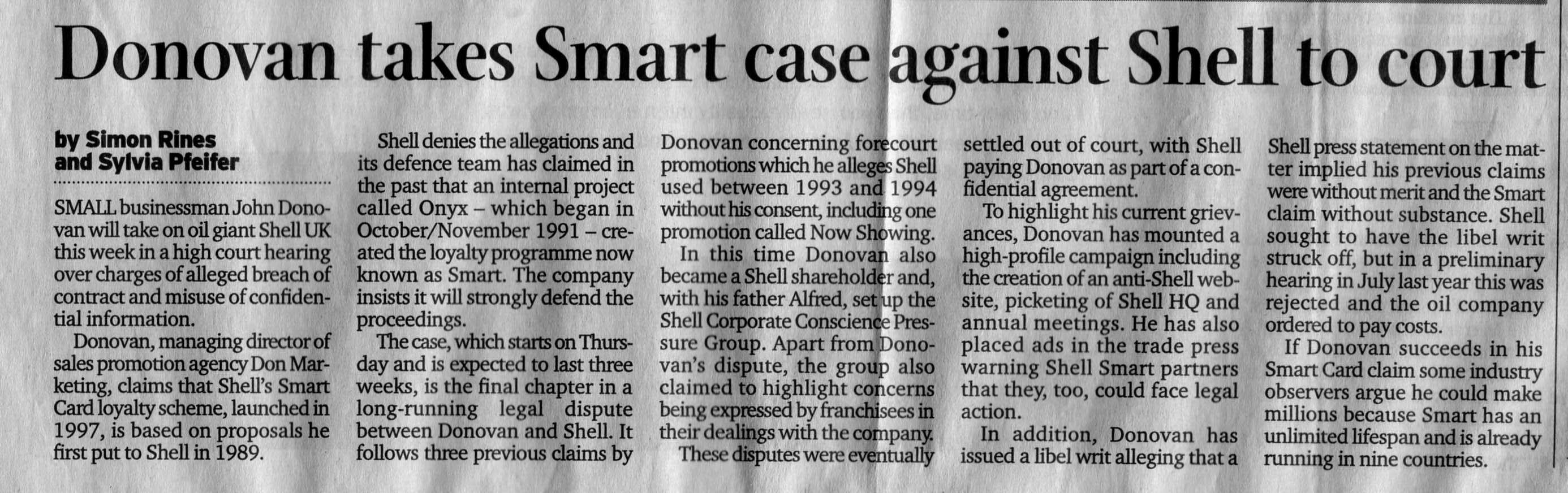
The two Donovans are well-known to Shell. They have waged a long-running anti-Shell campaign dating to the 1990s revolving around disputes over the rights to Shell gasoline-station promotions.
Over the years, the two sides have settled four lawsuits. But Mr. Donovan has continued his crusade. He has periodically picketed the company's headquarters and annual meetings.
In their complaint with the World Intellectual Property Organization, Shell attorneys argued that although there is no litigation outstanding between the two sides, the company believes the elder Mr. Donovan acquired the Web site "as a means of increasing his capability to disparage Shell at some time in the future."
A Shell spokeswoman declined to comment on the dispute, citing the pending arbitration.
Write to Chip Cummins at chip.cummins@wsj.com
John Donovan interview on Dublin Newstalk Radio 106fm - “The Breakfast Show with Eamon Dunphy”: Broadcast Thursday Morning 8.17am, 4 August 2005
EXTRACTS FROM THE INTERVIEW
Unofficial Transcript: Extraneous utterances have been deleted e.g. err
Substitute Host: Mick Clifford
Mick’s guests: Dr Mark Garavan (spokesman for the jailed men – the Rossport 5 - and for the related “Shell to Sea” campaign”): John Beasant (co-author of the recently published book SHELL SHOCK – THE SECRETS AND SPIN OF AN OIL GIANT) and John Donovan of ShellNews.net.
Mick’s introduction to the discussion:
Welcome back to the show the time now is 17 minutes past 8… Mick Clifford standing in for Eamon…
We turn again now to the story of the Rossport Five and it must be emphasised that this does involve a group of otherwise law abiding middle aged men separated from their families and their livelihoods and incarcerated all because of fears they have for their families safety…
Those fears about safety are unjustified the company Shall say yet the very same company has a record which is far from exemplary when its comes to safety and dealing with local people wherever they go to drill for resources…
First of all we have on the line Mark Garavan… (discussion takes place)
Mark Garavan: “the men were then committed by Shell to prison…” indefinite incarceration”…
Also on the line we have John Donovan, John runs a website ShellNews.net which describes itself as the worlds largest collection of news reports and revelations about Shell… Good Morning John…
John Donovan: Good morning to you
Mick: John on your website you have three predictions in relation to the Corrib gas field that you made at the beginning of this development… you suggested that the project would turn into a PR disaster for Shell… I think that’s certainly come true… you also predicted that the Irish government would turn on Shell… now I don’t know if that’s the case… but you also said that Shell would probably use undercover agents to gather intelligence and engage in other sinister activities against the protest group… what basis do you have for predicting that?
John Donovan: Its based on a pattern of undercover activity against other groups that have protested against Shell… In Nigeria and elsewhere… Our own background is that we have been involved is a series for disputes with Shell over the last decade… we’ve sued them in the High Court six times and what we didn’t.
Mick: why John…
John Donovan: pardon… we were running a sales promotion agency we worked for Shell for a decade… had a very successful relationship with them and then a new Shell management came on board that took a different stance towards its suppliers… they were very ruthless people… and we found to put it bluntly that they were stealing ideas that we had put to them in confidence… and launching them themselves and we did not take very kindly to that so we tried to talk to them and come to out of court settlements but we ended up actually issuing proceedings… and Shell has paid us several hundred thousand in damages over the years… but it has been a very difficult struggle because what we didn’t anticipate was that we would be faced with undercover activity…
Mick: Could you give us an example John of that type of…?
John Donovan: Yes… well it started of… we had many threats from Shell… to make the litigation drawn out and difficult because they wanted to drain the financial resources of a weaker opponent… and then we actually caught red-handed someone rifling through private mail at out offices and they presented fake credentials – a business card for a company which did not exist and eventually we managed to corner Shell… their Legal Director Richard Wiseman… into admitting that this was an undercover agent working for them…
Mick: and you’ve also suggested that people posing as journalist were working for Shell?
John Donovan: we were bombarded by… our solicitor was contacted by a gentleman who claimed to be working for The European newspaper… he flew in from Paris… interviewed me and some of our key witnesses… my suspicions were aroused by some comments that he made… I phoned The European and he wasn’t working for them to cut a long story short… We never established who he actually was working for but it was obviously someone with very deep pockets… he treated me to lunch at a very expensive restaurant and of course I thought I was dealing with a genuine journalist with interest in the story but he was obviously on an intelligence gathering mission for someone… apart from that we had a series of very suspicious burglaries my own home… the home of a key witness… even my solicitors house was burgled… all of our documents relating to the case were gone through… Shell admitted the undercover activity at our offices but they denied.. they categorically denied the other things that have happened since then
Mick: interesting… also on the line is John Beasant, John is the co-author of Shell Shock – the secrets and spin of an oil giant… a book he wrote with Ian Cummins… John Good Morning…
John Beasant: Good Morning Mick
Mick: John in your book you delve into the history Shell have of oppressing people… particularly the instance in Nigeria…
John Beasant: yes and listening to your two previous guests there… particularly the former one… there are alarming similarities between the way… the manner in which Shell conducted itself in the Niger Delta and its dealing with the Ogoni people… whose land and rivers were polluted by company pipelines… and the distressing story of those provocatively brave gentleman who now reside in jail in Dublin from County Mayo… alarming similarities… As I say… in the style and the manner in which Shell meets its opponents… and your previous speaker (referring to John Donovan) I must say his experience confirms very much the sort of material which was uncovered in the research stages of Shell Shock…
January 2007 BUSINESS NEW EUROPE: Shell gets stuck in a Sakhalin blog-mire
Derek Brower in Colchester, UK
2007-01-08
His office in a modest home in Colchester is littered with computers and other electronic equipment. A wide-screen television is tuned to BBC news. And the dog is in the car, so as not to disturb bne’s correspondent as he interviews John Donovan - David to Shell’s Goliath.
In December, Donovan, his 89-year-old father Alfred and a website he runs from his home in England’s southeast became famous. And, happily for a man who has devoted the past decade of his life to a grudge with Shell, it was all related to the Anglo-Dutch company’s problems on Sakhalin Island in Russia’s Far East.
Asked by a journalist from PetroleumArgus, a trade magazine, who his sources were for the environmental abuse charges he has laid against the Sakhalin Energy consortium developing a liquefied natural gas (LNG) project on the island, Oleg Mitvol, deputy head of Russia’s environmental watchdog Rosprirodnadzor, said he had “email correspondence between executives in Sakhalin Energy management from 2002.”
The kompromat, or compromising material, had come from Donovan, owner of the anti-Shell website www.royaldutchshellplc.com, Mitvol said.
Mitvol is an increasingly controversial figure in Russia. His campaign against Sakhalin Energy, a consortium led by Shell, has led to charges amounting to $30bn. He is also waging a campaign against Peter Hambro Mining, accusing the company of violations in the development of gold mines and pushing for the revocation of two licenses in the Yamal region.
Despite Mitvol’s claims to the contrary, few doubt that his eco-campaigning is related to Gazprom’s efforts to muscle in on the project. The Kremlin believes that the production-sharing agreement (PSA) it signed in 1996 with Shell and others has turned into a disaster. As the costs of the project have risen from $10bn to more than $20bn the time when Russia will begin profiting from a project developing its resources has become more distant. According to the terms of the PSA, the consortium is allowed to recover its costs before splitting revenue with the government.
Given that Gazprom wants into the world’s LNG market, the rising costs and the alleged environmental abuses seem to have been too good an opportunity to miss. The eco-charges laid the foundation for Gazprom’s efforts to get a share of the contract and on December 21 the Russian monopoly succeeded, taking a 50%-plus-one-share stake in the project at a cost of $7.45bn. Beneath a picture of Vladimir Putin at the top of Donovan’s website is the taunt: “Putin: Shell’s new boss?”
Either way - paying the fines or letting in Gazprom - Shell has been humbled on Sakhalin. And that makes Donovan and his father very satisfied indeed.
A running sore
Their website is an open wound for Shell. The Anglo-Dutch major has tried to shut it down on the grounds that it uses the company name. But it can’t, because www.royaldutchshellplc.com makes no money. For good measure, Donovan registered the site in the US, where laws on websites are weighted in favour of the domain owner.
“We wanted it to become a magnet for people who had a problem with the company,” says Donovan.
It has. The Ogoni tribe of Nigeria use the website to spread information about Shell’s activities in the Niger Delta. And Shell insiders frequently post on the site’s “livechat” facility.
“I’ve also heard that Athabasca Sands in Canada has some serious cost problems developing,” wrote one contributor in December, under the pseudonym SakhalinMollusc. “Anyone know if that is true or not? If so Shell is really on the ropes with Canaa [sic] & Sakhalin over-budget, reserves shrinking & Nigeria production being lost by the day.”
The site had 1.7m hits in November and gets more by the month. Shell has taken out injunctions to stop at least one of its disgruntled geologists from posting information on the site, says Donovan. But he adds that he still speaks to this insider on a regular basis.” And Donovan claims that he and his disgruntled insiders on the website were well ahead of the curve on Shell’s reserves scandal of 2003-04, in which the company was found to have inflated its oil and gas reserves by some 20%, or almost 4m barrels.
How the website came to the attention of Mitvol and the Russian government is indicative of just how bold Donovan has become in his fight against Shell. “I wrote to President Putin in 2005,” he says. The letter, says Donovan, offered the Kremlin inside information about how far Shell’s costs on the project would exceed the original plans. Donovan’s insiders now say the project could cost up to $26bn.
He didn’t get a reply. So he wrote to Mitvol, with more details about Shell’s environmental problems on the island. Mitvol didn’t reply either. But the silence, it has become clear, was not because Donovan’s information was being ignored.
The grudge that stole Christmas
For a man and his father who have devoted the past decade to waging a war against Shell from their home in Colchester, the Sakhalin news and Mitvol’s commendation of their work was a welcome Christmas gift.
The grudge goes back several years. Donovan and his father, who had been in the garage business since the 1950s, began selling ideas for promotions to attract customers to petrol stations. A typical scheme would involve a tie-in to a popular film. Shell liked the ideas that Don Marketing, the Donovan’s company, sold to them. Petrol and other sales increased by 30% on the back of some of the campaigns.
Then, says Donovan, in the early 1990s a new manager in Shell’s promotions division started stealing the ideas. They complained to the company’s senior management and were ignored. So the Donovans took to the streets with guerrilla tactics.
Alfred Donovan, already in his 80s, started visiting Royal Dutch/Shell’s headquarters in The Hague and in London. The two men and a handful of supporters picketed outside the buildings. And, using the company’s own language, they founded the “Shell Corporate Conscience Pressure Group” to pester the company about its behaviour. Driving up and down the motorway to petrol stations in the UK, the two men surveyed garage owners, canvassing their opinion of Shell and had the findings independently audited. “The results were spectacularly bad for Shell,” says Donovan. About 75% of respondents considered it an “unethical” company.
By the time the various lawsuits claiming that Shell had stolen their intellectual property approached a judgment in the High Court, Donovan claims he and his father had become victims of the company’s underhand tactics against them. “By coincidence or otherwise” their home and the homes of their solicitor and other witnesses in the trial were burgled. And a “journalist” who turned up to interview the men and others involved turned out to be no such thing. Then a man hired by Shell to investigate Don Marketing was caught going through their mail. Shell, says Donovan, admitted to having employed the snoop.
Donovan also alleges that personal connections between Sir Mark Moody Stuart, then managing director of Shell Trading, and the High Court judge ruling on the lawsuit undermined their claim. At the end of the trial, the judge commended Andrew Lazenby, the Shell employee at the centre of the Donovans’ claims, and criticised John Donovan. But Donovan also alleges that Shell had intervened when the men applied for Legal Aid, helping to ensure that their representation in court was weak. In the event, a criminal barrister represented John Donovan, and not a specialist in intellectual property. Alfred Donovan had no representation at all: his legal representation had to withdraw after legal aid was revoked.
Shell would not speak publicly about Donovan’s allegations to bne, but, privately, supporters of the oil company have reiterated the High Court judge’s condemnation of Donovan.
Donovan’s claims about Shell and its alleged tactics are wild and unverifiable. But Shell agreed to settle out of court, paying the Donovans a sum “in the thousands” as part of a “peace treaty” stipulating that neither party speaks about the matter in future. The Donovans were disappointed by the sum their claim had been for around £1m but accepted “under duress.”
That was in 1999. But, says Donovan, Shell then broke the “peace treaty” by making disparaging remarks about the men when another marketing contract that they were involved in came up before Shell.
And so Donovan launched his websites. Aside from “www.royaldutchshellplc.com“, earlier versions such as “www.shellsucks.com“, “www.shellnews.net” and “www.tellshell.net” (based on Shell’s own attempt to be transparent at www.shell.com/tellshell)also drew in commentary about controversial Shell activities, ranging from the reserves scandal, to Nigeria, to Shell’s efforts to build a “potentially environmentally calamitous” pipeline from the Corrib gasfield offshore Ireland to an onshore terminal.
The main site costs $2 a week to run. Donovan’s nephew, Nick, is the technological mastermind behind it. But the readers include Nigerian activists, anti-globalisers, international journalists, irritated Shell executives, and of course Alfred Donovan, an 89-year-old veteran of the Second World War whose sharp mind sits inside a diabetic body with only half a lung.
And the readers also include Oleg Mitvol and Russia’s environmental watchdog.
“Shell is not the worst oil company in the world,” says Donovan, “but we feel they mistreated us very badly.”
Donovan says Shell could have settled with the two men for £1m in 1998. Instead, Shell settled with the Russian government for $7.45bn.
Prospect Magazine: Rise of the gripe site: 25 February 2007: http://www.prospect-magazine.co.uk/article_details.php?id=8209
PDF version of article (takes a little time to load as multipage)
How two men and a website in Colchester humbled one of the oil industry giants
Derek Brower
(Derek Brower is the senior correspondent of Petroleum Economist)
It is not the kind of place you would expect to find at the centre of a global energy war. John Donovan's office is in a modest house in a suburb of Colchester. No electronic maps of Europe adorn his walls, as they do the walls of Gazprom's Moscow control room. And nor are there any butlers bringing cups of tea and expensive biscuits, as you find at Shell's head office on the Thames. There is just Donovan's 89-year-old father, Alfred, in the room next door.
But it is the home of www.royaldutchshellplc.com, a website which can claim to have cost Shell billions of dollars—and helped Vladimir Putin score another victory over western energy interests. This is how.
At the end of December, the Kremlin's politically driven campaign to win control of a liquefied natural gas project on Sakhalin island came to its predictable climax. The deal signed in Moscow between Shell and Gazprom saw the Russian company take 50 per cent plus one share of Sakhalin Energy, the consortium developing the project.
It was an offer that Shell and its two Japanese partners on Sakhalin could not refuse. The project, on a remote island notorious for its harsh winters, is one of the largest ever attempted. Sakhalin Energy will produce 9.6m tonnes per year of liquefied natural gas and 180,000 barrels per day of oil when it comes on stream in 2008.
But Sakhalin ran into serious problems. The most important was its escalating costs. Last year, Shell reported that the price of the project had doubled to $20bn. Insiders tell me that the figure is now closer to $26bn.
That would not be such a big problem if it weren't for the production-sharing agreement (PSA) that governs the project. PSAs are typically offered by countries that are desperate for oil majors to invest. To entice the companies, PSAs state that the host nation will only get a share of the profits once the developer has recouped its costs.
In the mid-1990s, when Shell signed the contract, the oil price was low and Russia was on its knees financially. Moscow needed the expertise Shell offered. But by the time Shell was announcing a doubling of costs on Sakhalin, President Putin was rather less respectful of foreign energy companies. The cost increase—which postponed, some said indefinitely, the moment when Russia would profit from the production of its own energy reserves—was too much for impatient officials in Moscow.
To get control of the project, the Kremlin, much to the joy of animal welfare and environmental groups outside of Russia, suddenly got green. It unleashed Rosprirodnadzor, the country's environmental watchdog, on Sakhalin. The alleged environmental abuses of the project—including deforestation, disruption of marine life, and careless infrastructure across an earthquake-prone region—are so bad that they "threaten to make Exxon Valdez look small," says one insider.
Oleg Mitvol—the deputy head of Rosprirodnadzor, who was entrusted with the job of bringing Sakhalin Energy to heel—had by last December accumulated sufficient evidence of Shell's and its partners' abuses to lay charges against the consortium amounting to $30bn. There were also threats that the licence to develop the project could be removed.
With the green gun at its head, Shell allowed Gazprom to take control of the project—giving Russia an immediate share of profits and oversight of costs. Taking the role of the humiliated man seriously, Shell's head Jeroen van der Veer thanked Putin for helping to resolve the conflict.
What most astonished Shell was the detailed inside knowledge Mitvol had accumulated about the company's abuses. Some in the company suspected industrial espionage. But it was actually information that the Donovans of Colchester were passing to Mitvol. The two men had received detailed material about Shell's ecological abuses on Sakhalin: a catalogue of corner-cutting, mismanagement and efforts to cover up damaging evidence. They say they got this information from Shell insiders. Mitvol clearly trusted the material, and in December he admitted for the first time publicly that his deep throat on Sakhalin was John Donovan.
The Donovan website has become an open wound for Shell. The Anglo-Dutch giant has tried to shut it down on the grounds that it uses the company name. However, as www.royaldutchshellplc.com makes no money, this hasn't worked.
"We wanted it to become a magnet for people who had a problem with the company," Donovan told me when I visited him recently. It has. The Ogoni tribe of Nigeria uses the website to spread information about Shell's activities in the Niger delta. And unhappy Shell insiders frequently post on the site's live chat facility.
"I've also heard that Athabasca Sands in Canada has some serious cost problems developing," wrote one anonymous contributor in December. "Anyone know if that is true or not? If so, Shell is really on the ropes, with Canada & Sakhalin over-budget, reserves shrinking & Nigeria production being lost by the day."
The site had around 1.7m hits in November. Its role in Shell's embarrassment on Sakhalin has raised its profile. Understandably, the company is worried about the information that leaks on to the website: Donovan says that it has taken out injunctions to stop at least one of its disgruntled geologists from posting on the site. He also says that his site and its whistleblowing insiders were well ahead of the pack on Shell's reserves scandal of 2003-04, when the company inflated its oil and gas reserves by some 20 per cent.
Donovan and his website have precursors. Another successful "gripe site," www.mcspotlight.org, has tracked McDonald's for years. It was founded after the famous McLibel trial that came to a climax in the high court in 1997, the fallout of which was a public relations disaster for the US fast food chain.
The best historical comparison with the Donovans and their fight, though, could be Ida Tarbell. One of the original "muckrakers," Tarbell's campaigning journalism against John D Rockefeller's Standard Oil, published in the early 20th century, eventually brought the company before the US courts. Antitrust legislation forced the break-up of Standard Oil into several smaller companies (Exxon, Mobil, Chevron and Amoco all rose from Standard Oil's ashes).
Tarbell's grudge began after Standard Oil had put her father's firm out of business. The source of John Donovan's grudge is similar, although it centres on the accusation that Shell stole intellectual property belonging to him and his father. They had been in the garage business since the 1950s and began selling ideas for promotions to attract customers to petrol stations. A typical scheme would involve a tie-in to a popular film. Shell liked the ideas that Don Marketing, the Donovans' company, sold to them, says Donovan, and sales increased by 30 per cent on the back of some of the campaigns.
Then, says Donovan, in the early 1990s, a new manager in Shell's promotions division started stealing the ideas. The men complained to the company's senior management but were ignored. Offended that a company with which they had worked for so long should treat them this way, the Donovans began their guerrilla war.
After various legal actions, Shell agreed to settle out of court, paying the Donovans a sum "in the thousands" as part of a "peace treaty" stipulating that neither party speak about the matter in future. The Donovans were disappointed by the sum—their claim had been for around £1m—but accepted "under duress." That was in 1999. But, says Donovan, Shell later broke the "peace treaty" by making disparaging remarks about them.
So Donovan launched his website—which costs only around £1 a week to run. And thanks to the ecological problems on Sakhalin, Shell's poor record for bringing projects on stream on time and on budget and the power of the web, the Donovan grudge against Shell came to a spectacular climax in December.
Donovan is not worried that his site became an instrument in the Russian government's ambition to become an energy superpower.
"Shell is not the worst oil company in the world," says Donovan, "but we feel they mistreated us very badly." Shell could have settled with the two men for £1m in 1998. Instead, Shell settled with the Russian government in December, with $30bn in fines hanging over the company's head.
one world trust Accountability in Action Newsletter July 2007: Royaldutchshellplc.com – The power of a website: 27 July 2007
EXTRACTS
Another example is the “gripe site” of www.royaldutchshellplc.com.
The site has played a watchdog function on the activities of Shell, and has acted as
acentral point for the gathering of complaints.3 With the power of the internet
harnessed for both whistleblowers and scandalmongers, it is clear that such great
influence can be positive or negative.
Whereas traditional media organisations have internal accountability – with editors
being ultimately accountable for published material – bloggers are independent and
lack such an institutional framework. There is no editor, no lawyer, and no
proprietor to be persuaded of the public interest case for a story. Even under the
UK’s notoriously strict libel laws bloggers are effectively able to circumvent the risk
of the large financial penalties that can come with an adverse court judgment. They
can limit liability through a company that holds few assets, as little is needed to
publish a blog. In the USA, where the Constitution places great value on the
freedom of speech, there are even fewer legal risks.
Accountability in Practice
Royaldutchshellplc.com–The power of a website
The website Royaldutchshellplc.com is a gripe site established by John Donovan
and his father, Alfred, to stream information to the public about the Shell Group, a
collection of oil, gas, and petrochemical companies. John Donovan’s use of the
website to blow the whistle on Shell’s environmental abuses in the Sakhalin project
exhibits the power an individual website can have in holding a global organisation to
account.
A‘gripe site’ is traditionally one “devoted to the critique and/or mockery of a person,
place, politician, corporation, or institution.”1 However, with the right contacts, a
gripe site can become much more than simply a soap box. As The Royal Dutch
Shell plc website shows, a gripe site can have a profound impact on global
organisations.
Donovan’s battle with Shell began over breaches of contract with regards to sales
promotions campaigns he and his father devised that were used to attract customers
to Shell petrol stations. Shell and the Donovans settled out of court. But it was after
Shell apparently made disparaging remarks about the Donovans that John set up
Royaldutchshellplc.com.
Donovan “wanted the site to become a magnet for people who had a problem with the company.”2 The site has not only cost Shell billions of dollars in Russia, but Prospect Magazine reports that the Ogoni tribe of Nigeria also use the website to spread information about Shell’s activities in the Niger Delta, and that even Shell insiders unhappy with the company use it.3
Royaldutchshellplc.com is just one of many examples of how the Internet makes it
possible for concerned individuals to initiate discussion about global organisations,
post and share information about organisational actions and their impact, and
provide a common forum for affected stakeholders. At the very least, ‘gripe sites’
such as this have a valuable watchdog function and remind global companies of the
power of public opinion – thus forcing them to confront weaknesses in their own
accountability.
1
Wikipedia, ‘Gripe Site,’ http://en.wikipedia.org/wiki/Gripe_site
2
Brower, Derek, ‘Rise of the Gripe Site’, Prospect Magazine, February 2007,
http://www.prospect-magazine.co.uk/article_details.php?search_term=shell&id=8209
3
Ibid.
Daily Mail: Shell on back foot as ‘gripe site’ alleges safety concerns: 1 September 2007
By Sam Fleming
‘As it stands we're on the back foot and our aim should be to develop a strategy (or options) that puts us in a more positive and secure position.'
‘Do we fully understand our own position. Are there on-going Issues that we need to know about/fix. Ensure we are on solid ground. Are we making the most of what we've got’
The Shell emails admitting the firm's concern at the claims
ROYAL Dutch Shell is getting rattled by a 'gripe site' that alleges there are safety problems with its North Sea oil platforms.
An internal Shell email admits the firm has been thrown 'on the back foot' because of claims put forward on the Royaldutchshellplc.com website.
John Donovan, who established the site with his father Alfred, has teamed up with former Shell employee Bill Campbell to highlight North Sea maintenance worries.
In recent weeks Campbell has emailed hundreds of MPs alleging Shell hasn't yet properly tackled health and safety failings. Shell's email, which was written in March, highlights that it needs to make sure it is 'on solid ground' when trying to stop negative publicity.
And it appears to acknowledge there could still be issues at its North Sea installations. 'Do we fully understand our own position. Are there on-going issues that we need to know about/fix,' asks the memo.
Shell was lashed for its safety record following two deaths at its Brent Bravo platform in 2003. A Shell spokesman said: 'Safety is Shell's foremost priority at all times. Shell strongly disputes any suggestion that we would compromise safety offshore. No fatalities are acceptable.'
The Royaldutchshellplc.com site has served as a forum for disgruntled current and ex-employees and campaigners.
Shell has sought to wrest the Royaldutchshellplc.com domain name away from Donovan, but the site remains active.
The spokesman added: 'Although Shell disagrees fundamentally with the factual basis and interpretation of much of the information on which the Donovans base their various allegations, the company has always refrained from commenting on specific issues raised by the Donovans and will continue to do so.'
Read more on Shell at thisismoney.co.uk/rdsb
Reuters: Shell loses exec on troubled Kazakh project-source: 4 September 2007
By Tom Bergin
LONDON, Sept 4 (Reuters) - A Royal Dutch Shell Plc (RDSa.L) executive working on Kashagan, a project under pressure from the Kazakh government for being overbudget and behind schedule, has quit, company sources told an unofficial company Web site.
John Donovan, who runs a Web site critical of Shell and acts as a conduit for whistleblowers at the company, said Shell insiders had told him that John Stubbs, a senior project manager on Kashagan, had left the Anglo-Dutch oil major.
Stubbs previously worked for Shell in Nigeria, where he had a leading role in the $3.6 billion Bonga oil and gas project, and the North Sea, where he was project director on the 876 million-pound ($1.8 billion) Shearwater gas development, which Shell said was up to 10 percent below budget.
A Shell employee told Donovan by email that Stubbs was one of an "elite band of great project management heroes" who had recently left Shell, leaving the company with a lack of talent to deliver on the big projects it is relying on for growth.
Shell said it was unable to confirm his departure.
The start of production at Kashagan has been delayed until the second half of 2010 from an initial 2005 target. Its cost has escalated from $57 billion to $136 billion, according to the Kazakh energy ministry.
The Kashagan consortium, led by Italy's ENI SpA (ENI.MI), has blamed industry inflation and complex geology for the cost overruns, but Kazakhstan accuses them of mismanagement and is pressing for compensation.
($1=.4966 Pound)
© Thomson Reuters 2009 All rights reserved
Daily Telegraph: Pressure on Shell over safety of platforms: 9 September 2007
By Russell Hotten, Industry Editor
Published: 12:01AM BST 08 Sep 2007
Shell will be unhappy that its standards and procedures are being questioned
Royal Dutch Shell is facing a growing campaign about alleged poor safety on several North Sea oil platforms, with Britain's biggest trade union and a former executive of the company calling on MPs and the Health and Safety Executive (HSE) to investigate.
Unite, formed from the merger of the TGWU transport union and Amicus, accuses Shell of neglecting safety on platforms it has recently put up for sale and has warned that a deterioration in relations between the company and staff is putting workers at risk.
Meanwhile, Bill Campbell, former group auditor of Shell International who has highlighted safety at the company for years, has now written to every MP and member of the House of Lords claiming to have evidence that the company has ignored problems.
Unite said in a statement: "Many platform areas are now not fully covered by trained and competent people and certain HSE safety-critical roles are not fully supported. The gaps in these safety-critical positions could be so severe that, in the event of an emergency, staff may be unable to cope."
Several Shell platforms - Cormorant Alpha, Dunlin Alpha, Tern, Eider and North Cormorant - are being sold as the company scales back activities in the North Sea, where finding and extracting oil and gas is becoming increasingly more expensive.
Shell denies strongly that it has ever compromised on safety and says that managers on the platforms have not complained of a lack of staff in safety-critical functions. However, safety is an emotive issue and Shell will be unhappy that its standards and procedures are being questioned. Nor will the union's plan to intensify its campaign help the company find buyers for the platforms.
A spokesman for Shell said yesterday: "We are aware that this [sale of the platforms] is an unsettling time for staff. Safety is our first priority and foremost on the agenda at all the affected platforms. We have asked personnel to raise any concerns personally with senior management so that we can understand and fully address them."
In a separate campaign, Mr Campbell wrote to MPs at the end of July saying that Shell is putting "lives at stake." He claimed to have a "vast amount of evidence" that Shell has failed to tackle health and safety concerns, but did not spell out the details in the letter.
Mr Campbell, who has teamed up with a website that has been highly critical of Shell, appears to be of increasing concern to the company. A recent internal email admits that the website has thrown Shell "on the back foot". The company declined to discuss Mr Campbell but said that if anyone raised a safety issue "we take it seriously and look at it".
Sunday Telegraph: Online revolutionaries: 10 September 2007
EXTRACTS
Revolutions used to happen in the streets - these days they take place online. And the targets are more often big businesses than bad governments. Banks, in particular, are feeling the brunt of grassroots internet campaigns.
Courts and trademark bodies are increasingly supportive of individuals and pressure groups when someone registers a domain name similar to that of their target so long as the site is non-commercial, with no subscriptions and no paid advertising.
Oil company Shell found this out when it tried, unsuccessfully, to claim ownership of the name Royaldutchshellplc.com. The website belongs to Alfred Donovan, now in his 90s, and his son John. The Donovans owned a chain of petrol stations in east London and Essex and created sales promotions campaigns for Shell. But they fell out with the company and aired their grievances online.
Their site became a hub for activists and disgruntled former employees. It has been used to mobilise support for environmental campaigns by the likes of WWF, the environmental lobbying group, against drilling in the Arctic and Russia, for groups worried about Shell's social impact in Ireland and Nigeria, and by the company's former group auditor Bill Campbell to raise issues about employee safety.
So-called "gripe sites" are as old as the web itself, but not everyone with an axe to grind can create a buzz.
Prospect Magazine: Shell’s Colchester headache: 12 September 2007
Derek Brower
In Prospects February issue, I reported on John and Alfred Donovan, two men with a combined age of 150 years in a house in Colchester who have been trying relentlessly to prick holes in one of the world's biggest companies, Shell. They seem to be succeeding. Their website has become essential reading for anyone who covers Shell and the energy sector more broadly. It gets up to 4.6m hits a month.
And it keeps causing problems for Shell. A few months after it emerged that the site had provided the Russian government with the evidence it needed to strip the company of its control of Sakhalin Energy, the Donovans pulled off another coup. One of the many Shell insiders who leak damaging information about the company on to the Donovan's website forwarded on the “inspirational” email sent by David Greer, then deputy chief of Shell-controlled Sakhalin Energy. Embarrassingly, the email “leaned heavily on the words of General George Patton,” according to the FT, which published all of it. Greer resigned soon afterwards.
In the last few weeks, more information about Shell's safety record on North sea platforms has gone public via the Donovans' website. Campaigners have now written to MPs about the issue, with one former Shell executive leading a political battle to have Shell censured for its alleged “Touch Fuck All” policy, under which workers were supposed not to meddle with equipment.
Now the Donovans have found another ruse to annoy Shell: the Data Protection Act (DPA). Shell has been fighting the two men from Colchester for decades. So the Donovans have made a series of “subject access requests” for any information Shell holds about them. So far, the company has surrendered two large folders, including an article about them by a director, a press release about them that the men claim is defamatory, and much else.
It's a fun game and an expensive one for Shell, given the man-hours such requests involve. As the Donovans' rights to access the information are enshrined in the act, Shell can't dismiss the claims. Yet the Donovans say that Shell has not surrendered all of the data that relates to them. The men have a copy of an email about them sent by Shell's most senior lawyer to the company's chief executive, Jeroen van der Veer. It isnt in the data Shell has conceded. And the Donovans also allege that Shell has now devised a codename for the men, to circumvent future subject access requests. If true, that would land Shell in hot water with the DPA commissioner. [UPDATE: see John Donovan's comment below]
Bizarre as it sounds, Shell knows that it must take the two men seriously. The company tried and failed to have their website closed down. And now it is paying the law firm Simmons & Simmons to handle their DPA requests. If that sounds a bit like using a sledgehammer to crack a nut, it shows how much of an irritation the Donovans have become for Shell. They frequently email senior executives of the company directly. And there is a regular stream of correspondence between their modest Colchester base and Shell's lawyers in London.
The Donovans say they have received CVs, business proposals, and even a terrorist threat sent to them: all were intended for Shell. (They kindly forwarded them on.) And the site has begun to break news regularly. Earlier this month, Reuters scooped that another senior Shell executive, this one a manager at the troubled Kashagan project in Kazakhstan, had quit. The Donovans, and through them Reuters, knew about the story before Shell's press office in London. As journalists and disgruntled employees have realised, if you want to know what's up at one of the worlds biggest companies or just want a good moan about the latest oil spill start with www.royaldutchshellplc.com.
*Clarification and update added by John Donovan:
We asked Shell if codenames were being used. Simmons & Simmons, the solicitors acting for Shell International Limited stated the following this morning, 12 September 2007, in a letter received by email:
“For the avoidence of any doubt, we are instructed that our client has not used code names for the purposes you allege or at all in relation to you or Mr Alfred Donovan. ”
We accept the answer provided.
The Times: Royal Dutch Shell at war with the Donovan family: 22 September 2007
Martin Waller: City Diary
Since the 1990s, Royal Dutch Shell has been at war with a family who registered a website, royaldutchshellplc.com. The Donovan family, led by 90-year-old Burma veteran Alfred, perhaps quixotically want Shell to change its management. Shell has failed to shut down the site, which has attracted job applications and, allegedly, even a terrorist threat, all of which are dutifully passed on to the company. Space does not allow exposition of all the correspondence between the two sides, but there are signs that Shell is developing a sense of humour. A recent letter from general counsel there suggests that “a truly alternative solution for all those people inadvertently contacting you is for you to choose a website and e-mail address without the word ‘shell’ in it”.
BBC Essex presenter Etholle George interviews John Donovan: 11 October 2007
Nikkei BP (Japan): Gripe sites are becoming more powerful: 13 November 2007
English translation by Ryo Kuroki from his article on the website of the top circulation Japanese Business Magazine: Nikkei BP
The turmoil of Sakhalin 2 was partly a result of anti-Shell movement
(By Ryo Kuroki, 12 Nov. 2007)
In the past people who hold resentment or grudge against a company were only able to appeal to newspapers and magazines or distribute handbills on streets. However, the media only reports on a small number of cases and the effect of distributing handbills by the roadside is very limited. People can also bring law suits, but Japan’s trial takes long time and the judgement is often not fair. It does not worth legal expenses you have to spend.
Gripe sites are becoming more influential in the West
The Internet is changing the situation. In the West gripe site are becoming more influential. Such sites are also called “corporate hate website”. If you have computers and internet connection, you can quickly disseminate information from home and it cost much less money and labour compared with conventional methods.
In the United States, there are various gripe sites on companies such as those on United Airlines, K. Hovnanian Homes, American Express, PayPal (remittance service company), Wal-Mart Stores, Inc., Microsoft, etc. Site owners and readers are those who have deep resentment or grudge against the companies.
For example, in case of United Airlines people are upset with ” lack of compensation and response in a sincere manner for delayed arrival or lost luggage “, in K. Hovnanian Homes case, “I bought a house with electrical wiring and water piping problems but the company never fix them”, in case of Paypal ” I called the company to report the problem many times, but they never provide a proper answer and the representative hangs up the phone in the middle of the conversation”.
British banks returned the fee of 2.6 billion pounds
In the West it is not an unusual thing that customers are treated badly. As I live in UK, I have many such instances, too. Emergence of gripe site is no wonder.
Recently, such sites are becoming powerful and bring serious result to companies.
British banks used to charge customers a penalty fee ( usually around 30 pounds ) for bounced cheque and unauthorized overdraft. But Martin Lewis, Manchester-born 35-year-old financial journalist, pointed out such penalty fee is illegal and launched a website “MoneySavingExpert.com” in 2003. The site provides information on bank charges and people can download from the site a format for claim letter to banks.
As a result, HSBC, Barclays, Royal Bank of Scotland HBOS and Lloyds Bank had to refund fees to customers. The amount refunded by these five banks in the first half of 2007 amounted to 400 million pounds ( about 960 billion Yen ). Britain’s leading daily newspaper “The independent” estimates the amount of fees that banks have returned is 2.6 billion pounds.
The fate of Sakhalin 2 was changed by two British men
There is a case where gripe site affected Japanese companies business. Sakhalin 2, which is an oil and gas development project in the Sakhalin Island by Royal Dutch Shell, Japan’s Mitsui and Mitsubishi, had to surrender majority interest to Gazprom due to pressure from the Russian government regarding the violation of environmental regulations (formal transfer of shares took place April this year).
However, it is not well known in Japan that actions of a 90-year-old man and his son who live in a countryside in UK contributed to the above movement.
Recently, I visited them. They live in the town of Colchester, southeastern part of the UK (Essex). The train from London takes just an hour there. It is an ordinary town with population of approximately 100,000.
Their house is 10-minute drive from the train station and situated in the middle-class residential area with the woods and fields nearby. The house is a two-storey brick house.
Mr. Alfred Donovan is currently 90 years old. He fought against Japanese army in the Burmese front as a communications officer. He worked as a marketing consultant for Shell, providing them with ideas to promote sales at domestic petroleum stations, etc.
However, in the early 1990s head of marketing dept. at Shell changed and, according to the claim of Mr. Donovan, Shell used an idea which Mr. Donovan presented on a confidential basis without his consent. Both parties went into litigation. It developed to 6 lawsuits on breach of contract and defamation. Eventually, due to mounting legal expenses, risk of losing home, psychological burden associated with long-running litigation, etc. Mr. Donovan had to settle many of the litigation outside court with a small payment from Shell.
They sent E-mail to Vladimir Putin and provided a Russian government official with information.
Still being resentful, Mr. Donovan launched a gripe site on Shell. The site’s domain name is “www.royaldutchshellplc.com.” He registered the domain name while Shell inadvertently forgot to do so. Shell tried to seize the domain name through WIPO (World Intellectual Property Organization) in 2005, but their appeal was turned down because Mr. Donovan’s site is non-profit purpose and he did not launch it with an intention to sell it to Shell.
The site contains critical news on Shell. Many former and current employees of Shell contribute information to the site. The information obtained through the site seems very insider.
In October 2005 Donovans contacted Russian President Vladimir Putin through the President’s website (The site has a function to send E-mail to the president). The purpose was to provide the president with insider information on the cost overrun of Sakhalin 2 project.
Also last year, they telephoned the office of Oleg Mitvol, deputy head of Russia’s environmental watchdog Rosprirodnadzor, and sent faxes on Sakhalin 2’s project design which was not appropriate to the local environment. Later Mr. Mitvol mentioned, in the interview with Argus Media ( leading energy market media ), that the Russian side used the information provided by Donovans in negotiations with project sponsors of Sakhalin 2.
Also, in June this year, the Financial Times reported that internal memorandum of David Greer, Deputy CEO of Sakhalin Energy Investment Company, was leaked to Mr. Donovan’s site. Greer left the company shortly after that.
” I’d like to make my site not just a gripe site, but the best site on earth about Shell ”
There are gripe sites in Japan, too. Some of those are ones created by victims of excessive lending by banks during the bubble era. For example, they are “Association of victims of Mizuho Bank”, ” Association of victims of Pair Life, Daiichi-Kangyo Bank, Mitsubishi Bank” ” Association of victims of Joyo Bank” and ” Sunflower Association (association of victims of counterfeit cash card theft)”.
However, these sites are not widely known by the public. On the other hand Martin Lewis’s “MoneySavingExpert.com” has 3 million hits a month and Mr. Donovan’s “www.royaldutchshellplc.com” has 4.6 million hits a month.
Japanese banks victims sites are solely for the purpose of appealing their problems to the public, while “MoneySavingsExpert.com” provides information on how to save not only bank fees but also utility bills, telephone charges, mortgage payments, local taxes, etc. Readers can download various formats from the site, too.
Mr. John Donovan, son of Alfred Donovan, says “I’d like to make my site not just a gripe site but the world’s best information site about Shell. Otherwise the reader will not visit it again”. To achieve this goal he is checking every day various newspapers, magazines and websites seeking information about Shell at his desk on which there are three computer screens (both men are retired and do not need to work).
Donovan’s site is used various anti-Shell people such as Nigeria’s Ogoni people who are against environmental pollution by oil companies and WWF (World Wildlife Fund) which opposes Sakhalin 2 project. Those people use the site to call actions and contact with each other.
Some crisis management companies started to advise how to deal with gripe sites
In Europe and the United States some crisis management companies started to advise how to deal with gripe sites. For example, immediate future Ltd ( an internet PR company headquartered in London) advise South Korea’s Samsung and Sony Europe.
I am, as a novelist, sometimes asked what the difference is between economic novels in the past and those of these days. My answer is as follows.
“In the past, a handful of influential people were making decisions. Accordingly economic novels only describe their backroom talks. However, due to the globalization which took place during the past 2 to 3 decades, the systems have become much more influential. Those systems are, for example, markets, investment funds, international treaties, WTO (World Trade Organization), legal system, SEC (the Securities and Exchange Commission) and other regulatory authorities, etc. Therefore, novelists have to spend more time describing the systems. ”
Internet sites are also “system”. They are expected to be more and more stronger vis-a-vis companies. This is good news for consumers. On the other hand companies could suffer from serious and unexpected damages if they do not deal with them properly.
References
“Top Corporate Hate Web Sites”, Charles Wolrich, 3 August 2005, Forbes.com
“Online revolutionaries - Today’s activists are giving business a bloody nose from behind their keyboards - not the barricades. But savvy companies are joining in,” Juliette Garside, The Sunday Telegraph, 9 September 2007
http://business.nikkeibp.co.jp/article/topics/20071108/140116/
Lloyd's/Dow Jones Newswires: UPDATE: US Court Ruling Paves For Shell Reserves Settlement To Proceed: 19 November 2007
"The ruling was first obtained by Shell critics’ Website Royaldutchshellplc.com, which has posted 2,000 pages of extracts from the case"
Corporate Reputation: Book by Dr Leslie Gaines-Ross: Published January 2008
Extracts from chapter entitled "Reputation Loss" pages 19 & 20: One such empowered activist is arch Shell critic Alfred Donovan. No one was more surprised than Royal Dutch Shell PLC to learn that this 88-year-old British army veteran had purchased the Internet domain name www.royaldutchshellplc.com . The gadfly Donovan was a well-known, though underestimated, critic of the company. By acquiring the domain name, Donovan obtained the perfect platform to voice his criticisms of the oil giant. Who would have thought a decade ago that such an unlikely individual could stand up to a corporate powerhouse, waging a war of words against one of the world’s largest companies?
The Reform of Class and Representative Actions in European Legal Systems: Book by Christopher Hodges, MA (Oxon), PhD (Lond), FSALS: June 2008: Front Cover, Pages 75 & 76, plus Back Cover.
The Netherlands
Case Study: Shell Hydrocarbon Reserves
On 9 January 2004, following an internal review, Shell (Royal Dutch and Shell Transport, the two former parent companies of the 'Shell Group') announced that it would re-categorise approximately 3.9 billion barrels of oil equivalent ('boe') out of its reported proved reserves. The re- categorisations were based on a determination that the reserves did not strictly comply with the definition of 'proved' reserves established by the US Securities and Exchange Commission ('the SEC'). On 24 August 2004, the UK Financial Services Authority and the SEC announced final settlements of their investigations with respect to Shell. As a result of the settlement, Shell, without admitting or denying the SEC's findings or conclusions, entered into a consent agreement with the SEC and paid a civil penalty of $120 million.
A number of putative class actions were filed in the United States against Shell in relation to the re-categorisation. One class action was commenced in the US District Court for the District of New Jersey. A non-US shareholder, Mr Peter M Wood, was recruited into that action through an appeal on the website (<http://www.royaldutchshellplc.com> accessed 10 June 2008). The US District Court for New Jersey initially ruled that Mr Wood could represent all non-US shareholders, but a new judge reversed the ruling on the issue of 'subject matter jurisdiction'.
After the announcement of the re-categorisations, the price of Shell's shares fell. Shell made an offer to compensate certain non-US shareholders for losses alleged as a result of the price fall, without any admission of wrongdoing, illegal conduct or causation of loss. Shell entered into an agreement with a foundation (the Shell Reserves Compensation Foundation) and various associations that represent the interests of retail shareholders and the institutional investors, including the Dutch Equity Holders' Association and others, under which non-US Shell shareholders would receive $352 million. The agreement called on the SEC to distribute $96 million of the $120 million fine to the non-US investors, an amount that corresponded to their share of investor base. The non- US arrangement would benefit both the shareholders who were parties to the agreement and other shareholders who fell within the definition of participating shareholders. That agreement was contingent on the US District Court of New Jersey declining jurisdiction over the non-US investors, which it did on 13 November 2007, and on approval by the Amsterdam Court of Appeal, which is expected to rule in early 2009. An agreement approved in this way would be expected to be enforceable throughout the EU.
In March 2008, Shell announced settlement in principle of the US shareholder class action claims for an additional $79.9 million plus $2.95 million, being proportional to the amounts payable under the proposed Dutch settlement, plus legal costs, subject to approval by the US Court. If the Dutch and US settlements are achieved, the combined cost would be around $600 million, including the $90 million paid in 2005 to the US employee shareholders. The US legal fees would be approved by the court as a percentage of the total recovery paid.
In practice, it should be understood that the Netherlands has two systems for collective claims. In addition to the Settlement Law discussed above, the litigation system permits a foundation or association to bring a collective claim without an individual lead plaintiff. Under that mechanism, there is no court supervision over appointment of lead counsel and it is only possible to bundle claims if there are no individual issues. No damages are claimable, but it has instead been the practice to request a declaration that there has been a breach. Res judicata only applies between the parties, and this is problematic for defendants, who want to avoid more cases.
SANTA BARBARA NEWS PRESS: Gripe Sites are all the rage now: 7 February 2009
SANTA BARBARA NEWS-PRESS
Gripe sites are all the rage now
Robert Eringer
EXTRACTS
Alfred and John Donovan, a father and son in Colchester, England, several years ago established the world's most effective adversarial Web site. Feeling aggrieved by treatment from the oil giant Shell, they created their site under the company's name, www.royaldutchshellplc.com. It strives, on a daily basis, to expose Shell's underside through research, investigation and leaks from inside Shell, which earned $35 billion in 2008.
"It is a way of taking on Goliath," John Donovan told The Investigator. "The Internet provides a low cost public platform for anyone to reach a global audience, giving ordinary individuals the opportunity to take on the powerful. Our David has already given Goliath -- with its 100,000 employees and business in 140 countries -- the PR equivalent of two black eyes."
Continued Mr. Donovan: "Our anti-Shell Web site receives several million hits every month and has become an interactive hub of dissent attracting whistleblowers who, through our Web site, have leaked many Shell secrets to the news media, resulting in huge embarrassment to Shell senior management -- and also to the resignation of a Shell senior executive."
The Donovans do not earn money from their Web site (they do not sell advertising or solicit
donations), but strive purely to sway public opinion against Shell and damage its business
prospects.
File of ALL news stories/articles in date order which mention or relate to royaldutchshellplc.com or the Donovan's battles with Shell
2009
Reuters syndicated article: "Shell gets tough on costs as oil prices bite" published on 30 January 2009 by numerous sources including: - London Stock Exchange (AFX News) Reference to the website: "Copies of the emails are available at www.royaldutchshellplc.com" |
Reuters syndicated article: "Shell eyes Mideast growth, to cut some jobs" published on 9 February 2009 by numerous sources including: - Reference to website: "Earlier, some employees posted comments on Shell protest website royaldutchshellplc.com saying up to half the jobs at the Dubai operation could go." |
The Intellectual Property Strategist: Grip Sites: Sue or Stew: By William G. Pecau
Extract
Gripe sites can be more than forums for criticism. Because some are run by or receive contributions from former employees or anonymous current dissatisfied employees, some gripe sites have access to and post non- public information about a company or its employees. Some of this information is false, some of it might be embarrassing, and some of it might be very harmful to a company.
One gripe site www.royaldutchshellplc. com, run by a former employee of Shell, credits itself with costing Shell billions of dollars. It claims to have disclosed environmental violations by a joint venture in Russia’s Sakhalin Islands that allowed Vladimir Putin’s government significant concessions from the Shell joint venture.
Reuters syndicated article: Shell to stall hires, and get "ruthless" on contractors published on 12 February 2009 by numerous sources including: - upstreamonline: Shell 'set to get ruthless' Reference to website: "A copy of the email is available on Shell protest site royaldutchshellplc.com to which Shell employees often post comments." |
First to reveal news of major restructuring of Shell by Peter Voser: 26/27 May 2009 Financial Times Newspaper front page lead story: 27 May 2009 Royaldutchshellplc.com, an independent website used by Shell staff, said yesterday that more than 30 per cent of senior managers were expected to go. FT Newspaper front page plus articles on pages 18 & 19: 27 May 2009 FT: Shell shake-up widely rumoured; E&P and G&P tipped to merge: 26 May 2009 5.06pm Reference to website: "Shell-watching blog royaldutchplc.com says it has assembled from ‘multiple sources inside Shell’ that not only will E&P and G&P merge, but that 30 per cent of senior managers/executives will also go. The company is apparently meeting in Berlin over the next two days and this will all be delivered by Peter Voser, the incoming chief executive, on Thursday." FT: Shell clears way for senior shake-up: 26 May 2009 18.53 Reference to website: "Royaldutchshellplc.com, an independent website used by Shell staff, on Tuesday said more than 30 per cent of senior management were expected to go." AFP: Shell: the owner of the gas division goes, rumor of reorganization: 26 May 2009 English Translation from French LONDON (AFP) - Shell announced Tuesday that Linda Cook, patroness of the division gas and energy giant Anglo-Dutch oil and candidate in the general direction, leave office on 1 June, a start could be the prelude a major reorganization. This will precede the start of the new CEO of Shell, the current finance director Peter Voser, scheduled for July 1st. The latter was preferred to Linda Cook and other candidates, including Malcolm Brindred, leader of the division “exploration and production”, to succeed Jeroen van der Veer. According to analysts, the announced departure of Linda Cook reflects Mr. Voser to make its mark without delay and to renew the framework of the group, even for a reorganization of its activities. Peter Hutton, the firm NCB, said that the resignation was “not unusual” on the part of a candidate aligned, adding that Linda Cook was deemed not to get along with Mr. Voser. However, he said the other main internal candidate for the post of general manager, Malcolm Brindred far to experience a similar fate, could not see its position strengthened by the departure of Ms. Cook, and recover all or part of its functions. “Peter Voser might seek to merge the gas and energy division in the upstream division + + (the industry” exploration and production “, ie), as is the case with the rival groups BP and Total, in order to generate economies of operation, “he anticipated. Meanwhile, the website royaldutchshellplc.com, led by Alfred and John Donovan, former employees opposed to the direction of the oil group, has confirmed these speculations, saying that Mr Voser would announce an overhaul of the organizational group Thursday, after a two-day meeting of the principals of the company to be held in Berlin. According to the site, said that based on internal sources of Shell, Mr Voser actually announce that day the integration of gas and energy division in the upstream division, and the disappearance of certain centers and regional decision removing a third of the senior group. DAILY MAIL ONLINE: Shell shock as long-timer Cook is first to go in Voser cull: 27 May 2009 Reference to royaldutchshellplc.com: Voser is expected to use the summit to announce the culling of almost a third of Shell's senior managers, according to a report on company gossip site Royaldutchshellplc.com yesterday. The unauthorised site, which has regularly obtained leaks from Shell insiders, said Voser will also announce the merger of Shell's Gas & Power and Exploration & Production divisions at the meeting, which may help explain Cook's departure. DAILY MAIL Newspaper: Shell shock as long time Cook is first to go in Voder cull: pdf version: 27 May 2009 By SAM FLEMING EXTRACTS Voser is expected to use the summit to announce the culling of almost a third of Shell's senior managers, according to a report on company gossip site Royaldutchshellplc.com yesterday. The unauthorised site, which has regularly obtained leaks from Shell insiders, said Voser will also announce the merger of Shell's Gas & Power and Exploration & Production divisions at the meeting, which may help explain Cook's departure. Dow Jones Global: Shell To Restructure, Merge Three Units : 27 May 2009 By JAMES HERRON LONDON -- Royal Dutch Shell PLC (RDSB.LN) said Wednesday it will launch a major company restructuring, merging its exploration and production, gas and power and oil sands units into two new divisions as new Chief Executive Peter Voser puts his stamp on the company. Shell's current global head of exploration and production, Malcolm Brinded, will head up the larger of the new divisions, called Upstream International. Marvin Odum, currently Shell's Executive Vice President for Exploration and Production Americas, will become director of Upstream Americas. The reorganization will affect around 24,000 Shell staff. A Shell spokesman declined to comment on how many jobs may be cut. Shell critic John Donovan reported on his blog Tuesday that more than 30% of senior executives at the two divisions could be culled. At 0820 GMT Shell B shares were down 0.5%, or 8 pence, at 1655p in a fairly flat London market. Company Web site: www.royaldutchshellplc.com ---By James Herron, Dow Jones Newswires; +44 (0)20 7842 9317; London Evening Standard (online): 27 May 2009 Senior managers at Shell today started a two-day conference where they will be told of large potential staff cuts. The summit in Berlin comes a day after the oil giant's head of gas, Linda Cook, left Shell after being passed over for the chief executive's role. That job is being taken up by Peter Voser, the company's finance director, on 1 July. Shell insiders' website Royaldutchshellplc.com reported that Voser will tell his top 100 managers that Cook's old division will be merged with exploration and production in a move aimed at dramatic staff cuts. It is believed this was Voser's platform on which he made his pitch to the board for the chief executive's job. Although oil prices have increased hugely in the past few months, at $61.59 a barrel today, it is still way down on the $147 at which it peaked last year, meaning Shell has to cut costs in order to retain its profitability. Meanwhile, staff flocked to Royaldutchshell.com to attack the group's management. One entry read: "Amongst those to be culled are (I suspect) many who are not only competent but who also realised that Shell historically was a bit different from the rest of the American oil major groups. No more. Sadly Shell is now the worst of the oil majors by far in almost every respect. And for those of us who in our small ways helped build a company that we were proud of its not just regrettable but a scandal." London Evening Standard: In newspaper: 27 May 2009 Shell braced for massive job cuts in Berlin summit Senior managers at Shell today started a two-day conference where they will be told of large potential staff cuts. The summit in Berlin comes a day after the oil giant's head of gas, Linda Cook, left Shell after being passed over for the chief executive's role. That job is being taken up by Peter Voser, the company's finance director, on 1 July. Shell insiders' website Royaldutchshellplc.com reported that Voser will tell his top 100 managers that Cook's old division will be merged with exploration and production in a move aimed at dramatic staff cuts. It is believed this was Voser's platform on which he made his pitch to the board for the chief executive's job. Although oil prices have increased hugely in the past few months, at $61.59 a barrel today, it is still way down on the $147 at which it peaked last year, meaning Shell has to cut costs in order to retain its profitability. Meanwhile, staff flocked to Royaldutchshell.com to attack the group's management. One entry read: "Amongst those to be culled are (I suspect) many who are not only competent but who also realised that Shell historically was a bit different from the rest of the American oil major groups. No more. Sadly Shell is now the worst of the oil majors by far in almost every respect. And for those of us who in our small ways helped build a company that we were proud of its not just regrettable but a scandal." The Herald (Scotland): New Shell chief ready to slash and burn: 29 May 2009 EXTRACT Shell will also set up a new division to handle project delivery and technology. It will be led by Matthias Bichsel, who is also Swiss. Some Shell employees complained on their website Royaldutchshellplc.com that a "Swiss Mafia" is running the group. ROMANDIE NEWS: Le nouveau patron de Shell Peter Voser imprime sa marque sans traîner: 27 May 2009 Mardi, le site royaldutchshellplc.com, animé par d'anciens employés opposés à la direction du groupe pétrolier, avait affirmé en s'appuyant sur des sources internes que le nouveau patron de Shell allait sabrer le tiers des postes de cadres supérieurs. "Forcément, il y aura des emplois en moins", mais Shell ne s'est pas fixé d'objectif en la matière, a assuré de son côté un porte-parole du groupe à l'AFP, qualifiant les affirmations de royaldutchshellplc.com de "pures spéculations". Extracts using Google English translation: Tuesday, royaldutchshellplc.com site, hosted by former employees against the group management oil, had argued on the basis of internal sources as the new boss of Shell would cut one-third of senior management positions. "Inevitably, there will be fewer jobs, but Shell did not set a goal in the subject, assured of its later a spokesman for the group to AFP, called the assertions of royaldutchshellplc.com "pure speculation". 529 Dutch Website; 27 May 2009 Volgens de blog royaldutchshellplc.com gaat het vooral om ondersteunend, administratief en IT- personeel. Verder zijn er geruchten dat 30% van het managament zijn baan verliest, wat Shell ontkent. Wel staat in een uitgelekte e-mail die Peter Voser vanochtend aan het personeel stuurde dat "minder mensen meer strategische beslissingen gaan nemen". Our behaviours need to change if we want to enable leadership performance in a strong performance culture. That will mean that fewer people will make strategic decisions. More people will implement them, and improving performance will be our guide and goal. We will become a simpler place to work. Fragment van Vosers e-mail, lees hier de hele mail le nouvel Observateur: 27 May 2009 le nouvel Observateur English Version: Shell reorganizes: 27 May 2009 Tuesday, royaldutchshellplc.com site, hosted by former employees against the direction of the oil company, had argued on the basis of internal sources as the new boss of Shell had decided to remove a third of senior management positions. China Money 163.com: 27 May 2009 ?????????? ????????????Royaldutchshellplc.com???????30%????????? DutchDN: Snur Shell på hodet: 27 May 2009 EXTRACT: Ifølge royaldutchshellplc.com, som er et uavhengig nettsted for Shell-ansatte, vil mer enn 30 prosent av høyere ledere måtte gå. DutchFEM: "Grondige reorganisatie Shell": 27 May 2009 Om kosten te besparen zou de nieuwe ceo van Shell 30 procent van de senior managers een gouden handdruk willen geven, zo schrijft Shell-criticus John Donovan op zijn website. Die informatie zegt hij van binnen het bedrijf te hebben. fd.nl: 'Nieuwe Shell-CEO gaat grootscheeps reorganiseren': 27 May 2009 26 mei 2009, 17:30 uur | FD.nl/DJ AMSTERDAM (FD.nl/DJ)--De nieuwe CEO van Royal Dutch Shell, Peter Voser, kondigt donderdag een grootscheepse reorganisatie van het bedrijf aan, waarbij meer dan 30% van de topmanagers en bestuurders sneuvelt. Dat schrijft Shell- criticus John Donovan dinsdag op zijn weblog, op basis van anonieme bronnen bij het bedrijf. Behalve het vertrek van 30% van het hogere management zou het plan een fusie omvatten van de divisies Exploration & Production met Shell Gas & Power. De bekendmaking zal volgens Donovan worden gedaan tijdens een vergadering van honderd topmanagers van het bedrijf in Berlijn. Een woordvoerder van Shell wilde niet reageren op het bericht. Archie van Riemsdijk; FD.nl/DJ; +31-20-5928456; archie.vanriemsdijk@dowjones.com Copyright (c) 2009 Het Financieele Dagblad koers alarm.nl: 27 May 2009 Gisteren viel op de weblog van John Donovan al te lezen dat Shell een grootscheepse reorganisatie zal doorvoeren. Donovan meende dat de opvolger van Jeroen van der Veer, Peter Voser, a.s. donderdag tijdens een bijeenkomst van honderd topmanagers de actie zal aankondigden waarbij het management van de oliereus niet zal worden gespaard. Naar verluidt zal 1 op de 3 topmanagers het veld moeten ruimen. z24nl: 27 May 2009 De reorganisatie moet leiden tot een hogere efficiëntie en zou nodig zijn vanwege de sterk gedaalde olieprijs. Shell kon nog geen commentaar leveren op de berichtgeving. De website Royaldutchshellplc.com meldt dat 30 procent van de senior managers zou moeten vertrekken. |
Reuters syndicated article: "Shell to cut 350-450 senior managers in overhaul - web site" published on 30 May 2009 by numerous sources including: - SINA.com (China) REUTERS ARTICLE Shell to cut 350-450 senior managers in overhaul - web site Sat May 30, 2009 9:49am EDT LONDON, May 30 (Reuters) - Royal Dutch Shell Plc (RDSa.L) plans to cut 350-450 senior management roles as it restructures to cut costs and improve operational performance, according to a website to which Shell employees post internal information. The cuts represent almost 30 percent of Shell's "Senior Executive Group" layer of management, John Donovan, the operator of the Royaldutchshellplc.com website said. Earlier this week Shell announced a major restructuring but gave no targets for job or cost cuts. [ID:nLR946279] The Royaldutchshellplc.com website was the first to reveal news of the planned restructuring. Shell declined to comment. (Reporting by Tom Bergin, editing by Mike Peacock) © Thomson Reuters 2009 All rights reserved |
Wall Street Journal / Dow Jones Syndicated article "Leaked Shell E-mail Reveals 62 Senior Executive Appointments" published on 22/23 June 2009 and by other news sites (http://online.wsj.com/article/BT-CO-20090622-708702.html) WALL STREET JOURNAL/DOW JONES NEWSWIRES: Leaked Shell E-mail Reveals 62 Senior Executive Appointments (Alternative copy) JUNE 22, 2009, 11:26 A.M. ET LONDON (Dow Jones)--An internal e-mail from Royal Dutch Shell PLC (RDSB.LN) leaked to a blog critical of the company has revealed the appointments of 62 senior executives to new roles within the restructured company. The e-mail dated June 16, sent by incoming Chief Executive Peter Voser, was published Saturday on the blog royaldutchshellplc.com. A Shell spokesman said the company does not comment on purported leaks. Effective July 1, Ceri Powell, former Executive Vice President, or EVP, for Strategy becomes EVP for Exploration for the company's international operations, the e-mail said. Dave Lawrence, former EVP for global exploration moves to head up exploration in the new Shell Americas division. Ian Craig, the former head of the Sakhalin-2 liquefied natural gas project in Russia becomes EVP for Sub-Saharan Africa and will oversee the company's troubled Nigerian operations, the e-mail said. Former Africa chief, Ann Pickard, becomes EVP Australia. Charles Watson, former EVP of Shell Energy Europe, will head the company's Russian and Caspian upstream operations. All the above executives will report to the global head of Exploration and Production, Malcolm Brinded. Blog Web site: http://tinyurl.com/lsjxwm -By James Herron, Dow Jones Newswires; +44 (0)20 7842 9317; james.herron@dowjones.com |
Wall Street Journal / Dow Jones Syndicated article "Shell Email Leak Says US Convent Refinery Income Dismal -Blog": published on 17 July 2009 and by other news sites THE WALL STREET JOURNAL AUGUST 3, 2009, 6.13 A.M. By Benoit Faucon of DOW JONES NEWSWIRES LONDON (Dow Jones)--A Royal Dutch Shell PLC (RDSB.LN) list of over 300 vice presidents, some of whom have been recently appointed, available on a critic's blog shows that the restructuring started by new Chief Executive Peter Voser is deepening. The list, obtained by Website Royaldutchshellplc.com, was drawn after Voser launched a top management shake-up in the Anglo-Dutch oil major as it tries to adapt to the new reality of lower oil prices. The company, when contacted by Dow Jones Newswires, said it doesn't comment on internal documents. The restructuring has already been seen as a factor behind the high profile departure of head of gas and power Linda Cook. But the list shows the changes are now moving from top executives to lower levels of management. As an example, African gas manager De la Rey Venter is now listed as VP for Shell's critical global liquefied-natural-gas new business. Bart van de Leemput is adding the management of Shell's Dutch onshore joint-venture Nederlandse Aardolie Maatschappij to his responsibility as vice-president for non-operated European upstream ventures. Many managers, however, remain at their current position. That's the case for Mutiu Sunmonu, VP production for Africa which embattled business has recently made headway with some output resumption. By Benoit Faucon, Dow Jones Newswires; +44-20-7842-9266; benoit.faucon@dowjones.com Wall Street Journal: CORRECT(7/17): Shell Email Leak:Convent Refinery Income Dismal: 21 July 2009 |
The Sunday Times: Two men and a website mount vendetta against an oil giant: 19 July 2009 (Times Online)
Pdf of article publish in newspaper (contains an subtitle below the graphics/photo display: "They just go on digging: the Donovans' campaign has caused Shell expense and embarrassment at its operations in Russia, which include the Sakhalin gas project and drilling in the Sea of Okhotsk")
Shell has taken some big knocks in the attack by a father and son in Essex
Danny Fortson
By his own admission, John Donovan is “truly obsessed”. Standing in his kitchen, the 62-year-old proudly opens the cabinets to reveal shelves stacked not with food but piles of papers and ring binders.
“We don’t cook much,” he said with a chuckle. “Every cupboard in this house has papers in it. It’s the same in my bedroom; the garage is full as well. I have built up so much information so when we put something into print, we can back it up.”
A man obsessed indeed. His modest three-bedroom house in Colchester, Essex, is home to what is probably the world’s largest dossier on Royal Dutch Shell. It also serves as the headquarters for royaldutchshellplc.com, the website where Donovan and his father Alfred – frail but lucid at 92 – pursue a surprisingly effective crusade against the world’s biggest oil company.
So called “gripe sites” are common, especially for companies in highly-emotive areas such as oil, tobacco and banking. Last week Goldman Sachs decided to settle a suit filed against the man who runs a site called goldmansachs666.com after the case garnered celebrity and boosted traffic to the site. The Donovans, though, are more adept than most at inflicting damage on their target.
Their site has become a major thorn in the side of Shell, publishing a relentless stream of insider leaks and negative commentary. It is a remarkable study in the power the internet can have when it is coupled with a couple of industrious individuals with a vendetta.
John estimates that he has published more than 24,000 articles about Shell in the decade and a half since he and his father took their cause online. The website regularly publishes stories, fed to it by a handful of disgruntled executives, which are then picked up by the main-stream press. It has become a hub of activity for antiShell former employees and environmental activists. Last month it had 1.7m hits.
A few weeks ago, for example, it published a plan by new chief executive Peter Voser to slash thousands of jobs before the company was ready to make an announcement. In 2005, when the Kremlin was building a case against Shell over the Sakhalin gas project, the Donovans provided confidential documents regarding alleged environmental infractions directly to Oleg Mitvol, the minister who led the case.
Shell was ultimately forced to sell a stake to the Russians, leading to billions in lost revenue. Mitvol publicly acknowledged the help provided by the Donovans in building his case.
If only Shell knew 20 years ago what it knows now. Back in the 1980s the Donovans had a good relationship with the oil giant. They ran a marketing company that created petrol station promotions for Shell and both sides did well out of the partnership. When a new executive took over marketing, he used several of their schemes but refused to pay for them. So in 1992 they sued. After three legal actions, a fourth ended up in the High Court. In the meantime, Alfred paid people to leaflet Shell’s headquarters on the Thames in central London and they started a pair of antiShell websites.
With legal bills mounting they agreed a “peace treaty under duress” in 1999. It was not the end of the story. Sitting in the cramped study that is the operations centre for the website, John pulls a framed, A4-size oil painting from the wall. It is of Alfred’s former country home that he had to sell in 2000 to pay legal bills. “We had a good life and we had to give our mortgage to our barristers,” he said.
“Perhaps it was a mistake to pursue a case against a big corporation. Maybe it’s my Irish blood but I couldn’t accept it. It changed our lives.” Shell has been paying for it ever since.
In 2007, after the Donovans began airing concerns about safety in the North Sea, internal Shell e-mails admitted that the company was “on the back foot” and needed to “develop a strategy (or options) that puts us in a more positive and secure position” in dealing with the Donovans.
Neither man appears particularly embittered. If anything, they seem quite tickled to be able to give Shell a good kicking. Alfred, a second world war veteran who fought the Japanese in Burma, said: “It’s a laugh.”
Yet what they choose to print doesn’t always fit with their affable demeanour. Last year they published comments by one of their regular contributors who compared a Shell executive to Joseph Fritzl, the Austrian convicted of imprisoning and raping his daughter in a dungeon for nearly two decades. Shell is thought to have considered legal action but decided that publicity would only inflame the situation.
A Shell spokesman said: “The site has a well-known and long-standing agenda. Healthy debate is welcome and encouraged but we choose not to take part if it sinks to the level of personal attacks and innuendo.”
Despite their shoestring budget and minimalist operation, the Donovans are canny operators. When they started up royaldutchshellplc. com in 2005, they incorporated it as a nonprofit site in America, where domain name law is strong. This move served them well. Shell tried to strip them of the site soon after it was opened, labelling them “cyber-squatters”, but the World Intellectual Property Organisation ruled in their favour. The Donovans have since rebooted their two predecessor websites so that the public can access all the information housed there as well.
It is an awkward position for Shell, which was this month crowned by Fortune magazine as the world’s largest company. Trying to shut the website down would draw even more attention to it but letting it continue subjects the company to a constant barrage of negative news, allegations and insults, some of which is picked up by the mainstream media.
In view of Alfred’s advanced age, John does most of the donkey work. He has the time. Unmarried and with no children, the only thing that occupies his time other than the website is his yellow labrador, which he takes for an hour’s walk every morning. He spends six hours a day, seven days a week on the site, fielding e-mails, publishing articles and corresponding with contributors. “It keeps my mind active and I get a kick out of it because we are able to help people,” he said. A nephew helps with the technical aspects of the site. They do not make any money from it and pay just $125 (£77) a month to maintain it.
John doubts that he will ever shut up shop. “There is no ultimate goal,” he said. “We started something and it has grown way beyond what we thought it would. It’s something where people can get revenge on the company or point out things that are wrong. If we can prove it, that’s a real problem for a company like Shell.” In a parting shot he said: “I will continue as long as my health holds up. Since my dad is 92, things don’t look good for Shell.”
Financial Times: ft.com/energysource: The Source: Nissan’s batteries; oil in Angola and Kurdistan; Exxon’s algae; where is Saudi Arabia’s gas; ethanol from corn cobs, and more: 20 July 2009: By Kate Mackenzie On Energy Source: Nissan’s battery plant to create real green jobs Chinese oil deal in Angola shows how asset prices have cooled off Kurdistan’s oil still lures investors Slow and steady, the Exxon way Further Reading: An exercise in futility: Looking for gas in Saudi Arabia’s Empty Quarter (The National) The US LNG import surge may have been overstated (chron.com) Oil analysts bearish on current prices, but say $147 a barrel is likely to return (The Barrel/Platts) POET’s head of science on making cellulosic ethanol from corn cobs viable (R-Squared) About that £50m earmarked for UK marine power development… (Guardian) Energy storage + smart grid = cheap, cool (SeekingAlpha) Why royaldutchshellplc.com do what they do (The Times) North Dakota Democrat Senator won’t support cap-and-trade bill, citing speculator bubble fears (Platts) Surprise, surprise: wealthier households produce more carbon emissions (The Telegraph) |
Wall Street Journal / Dow Jones Syndicated article "Shell's Leaked 300 VPs List Shows Deepening Restructuring": published on 3 August 2009 and by other news sites fd.nl Het Financieele Dagblad : Gelekte lijst VP-posities Shell toont verdieping reorganisatie DeBeurs.nl (In Dutch): Gelekte lijst VP-posities Shell toont verdieping reorganisatie |
Dow Jones Syndicated article "2nd UPDATE: Shell To Unveil More Job-Cut Details Soon": published on 4 September 2009 by various news sites John Donovan, the blogger managing Royaldutchshellplc.com, a Web site critical of the company, said he was told by his sourcesproduction division will be cut by 15%. |
Shell Job Cuts Media Coverage 5/7/8 September 2009 Sun: Shell axe 'warning' (Newspaper) OIL giant SHELL is preparing to axe more than 2,000 of its staff, it was claimed last night. Sources said that middle-managers had been told in an internal email that “the coming days will bring more information about Shell’s reorganisation”. A Shell protest website – royaldutchshellplc.com – claimed 15 PER CENT of the company’s exploration and production team could go. Shell, which axed 150 top managers in July, has previously warned that 24,500 would be “affected” in some way by chief exec Peter Voser’s restructuring plans. The company refused to comment last night. Financial Times: Shell set to unveil job cuts (Website) 5 Sept 2009 Royaldutchshellplc.com, an independent website used by present and former Shell staff, said:“Although precise figures have not been supplied to us, our estimate based on an analysis of the leaked information received, is that on average, staff numbers [in exploration and production] will be cut by 15 per cent.” It said some experienced staff expected to have to re-apply for their jobs. Financial Times: Shell set to unveil job cuts (Newspaper) pdf Calgary Herald: Oilpatch yearns for end to layoffs Extracts: Meanwhile, Royal Dutch Shell PLC could be planning job cuts of around 15 per cent in its core exploration and production unit which includes Shell Canada, Reuters reported on Friday, citing sources inside the oil major. An announcement on a restructuring of the unit, which generates most of the company's profit, is due on Monday, Shell protest website Royaldutchshellplc.comsaid. Shell declined to comment. In May, Europe's largest oil company by market value said it planned to restructure its exploration division and divide it into two units, one focused on the Americas and another focused on the rest of the world. © Copyright (c) The Calgary Herald Business Day (South Africa): Royal Dutch Shell said to be planning job cuts LONDON — Royal Dutch Shell would today announce its plans to cut about 15% of the jobs in its core exploration and production unit, a Shell protest website reported on Friday. An announcement on restructuring the unit, which generates most of Shell’s profit, was due today, website Royaldutchshellplc.com said, citing sources inside the oil major. Shell declined to comment. In May, Europe’s largest oil company by market value said it planned to restructure its exploration division and divide it into two units, one focused on the Americas and another focused on the rest of the world. Since then, new CE Peter Voser has announced hundreds of job cuts across the company as it struggles with plunging revenue after oil price futures collapsed from a record above 147 a barrel in July last year. On Thursday, Standard and Poor’s lowered its long-term rating on Shell to “AA” from “AA+”, citing concerns about its cash flows. The website did not say how many jobs would be affected. Finanmagru (Russia) DAILY MAIL thisismoney Daily Mail & This is Money: Oil giant Shell prepares to cut jobs 8 September 2009, 10:04am Royal Dutch Shell managers are beginning the grim task of telling staff where job cuts will fall as new chief executive Peter Voser wields the axe. A report on company protest site royaldutchshellplc.com said about 15% of
jobs in the exploration and production unit will be lost and employees will be However, there is doubt over that figure as reductions have not been finalised yet. Shell declined to comment. Voser has said thousands of positions will go as he slims down the oil leviathan in a plan called Transition 2009. In an email to staff last month he said: 'We continue to operate in a challenging environment. That reinforces the urgency for us to step up our cost reduction efforts.' The 'A' shares rose 18p to 1,703p yesterday. In July, Voser struck a grim tone as he unveiled a 70% crash in second-quarter profits to £1.4bn. He also announced plans to hack capital spending by 10% and push through 'substantial' cuts to the firm's 102,000-strong workforce. It follows a 17,000 reduction in headcount between 2003 and 2008 and a cull of a fifth of the firm's top managers already this year. 'We simply don't know when the global economy will recover, and we have to
plan on the basis that this downturn could last quite some time,' said Voser at World oil demand will fall by over 2m barrels-a-day this year, the sharpest fall since 1980, according to Shell. This time last year, firms were riding high on the back of oil prices that peaked at $147 a barrel. But the global recession pushed prices almost down to $30 a barrel early in 2009. Since then, prices have recovered above $70. |
Reuters syndicated article: "Shell to cut jobs in core exploration unit-website" published on 4 September 2009 by numerous sources including: - Reuters: UPDATE 1-Shell to cut jobs in core exploration unit-website Geld.de (Germany) (rp online) EL ECONOMISTIC.com.mx (Mexico): Recortará Shell 15% de sus empleos en producción y exploración LONDON, Sept 4 (Reuters) - Royal Dutch Shell Plc (RDSa.L) is planning job cuts of around 15 percent in its core exploration and production unit, a Shell protest website reported on Friday, citing sources inside the oil major. An announcement on a restructuring of the unit, which generates most of Shell's profit, is due on Monday, website Royaldutchshellplc.com said. Shell declined comment. In May, Europe's largest oil company by market value said it planned to restructure its exploration division and divide it into two units, one focused on the Americas and another focused on the rest of the world. Since, then new Chief Executive Peter Voser has announced hundreds of job cuts across the company as it struggles with plunging revenues after oil prices collapsed from a record above $147/barrel in July 2008. On Thursday, ratings agency Standard and Poors lowered its long-term rating on Shell to "AA" from "AA+", citing concerns about its cash flows. The website did not say how many jobs would likely be affected by the plan. (Editing by David Cowell) |
The Guardian: 92-year-old's website leaves oil giant Shell-shocked: Mon 26 October 2009 How online protesters are using 'gripe site' as the focus for their complaints about big business Comments (9) Russell Hotten At 92 years old, Alfred Donovan is an unlikely online campaigner. But he and his son John, 62, have been a painful thorn in the side of Royal Dutch Shell for more than a decade. The pair run one of the oldest and most effective "gripe sites", and the oil giant's army of well-paid lawyers do not know how to neutralise them. The number of so-called "gripe sites", which exist to criticise, mock, and generally annoy companies, people, and institutions, has exploded in recent years, and the trend is set to continue. Take this month's campaign against the super-injunction obtained by the lawyers Carter Ruck on behalf of Trafigura. Thousands of Twitter users, empowered and astonished at the campaign's success, are expected to look afresh at how the internet can be used to fight against big business. "The anti-Trafigura campaign really brought home – even to someone like me – the power of the internet and new media," says John Donovan, a former marketing entrepreneur. "Once, you could never hope to take on companies that had loads of money and lawyers. Now there is an alternative to legal action. You can make a big impact with very little cost." Last week the Donovans were leafleting outside Shell's London HQ to advertise their website, www.royaldutchshellplc.com. But they hardly need the publicity – the site had more than 2m hits last month – and leafleting was just another way of goading a company they have been at war with since the early 1990s. The site is so successful that Kremlin officials and US investigators have used it. Journalists, knowing that the site regularly receives juicy leaks from Shell employees, search it for stories. Since setting up his first anti-Shell site in 1995, Donovan estimates he has published about 24,000 articles about the company. One early and successful gripe site was www.mcspotlight.org, founded after the celebrated McLibel trial involving McDonalds in 1997. Another site, www.ihatedell.net, carved a niche as a forum for critics of the Dell computer company. Dell's answer was to engage with its critics rather than use legal muscle to close them down. In contrast the investment bank Goldman Sachs failed in a legal bid against www.goldmansachs666.com. Katy Howell, the director of Immediate Future, which specialises in social media, believes Dell made a textbook response to its gripe site. "Dell spoke to its critics and responded to their concerns. They turned a negative into a positive," she says. The Donovans' campaign was prompted by a grievance over claims that Shell stole intellectual property from their marketing company. The legal bills from four court cases in the 1990s almost crippled the two men. Shell fully investigated the Donovans' claims, and in 1999 agreed a "peace deal" under which the pair got an undisclosed sum. However, the payment was far less than the £1m they wanted. The Donovans claim Shell then breached the agreement by talking publicly about the case. Shell denies breaching any part of the agreement with the Donovans. Since then, Shell is thought to have contacted the Donovans at least once, using a middle man, to resolve the dispute. John Donovan will not comment on this but shows no sign of agreeing to mediation. Four years ago Shell was embroiled in a bitter dispute with Russia's environmental regulator over drilling for gas at Sakhalin Island. It was eventually forced to relinquish its majority stake in the project, costing Shell billions in lost revenue. Later, the regulator, Oleg Mitvol, publicly acknowledged the Donovans' help in getting information about alleged claims of environmental abuses by Shell. The company has denied breaking any environmental regulations. Earlier this year the site disclosed plans for thousands of Shell job losses. And now, Donovan says, he is helping US investigators looking into the award of oilfield drilling licenses, providing them with information leaked to his website. The site has broadened its coverage to include other stories about the oil and gas industry. "I knew when I started the site that if it was static – just with the same story – people would visit us once and never again," says Donovan. "So I brought in a news element, mixing negative but also positive stories about Shell." But "kicking" Shell is still the site's raison d'etre, and Donovan has no intention of easing up. "My father is 92. So if I live that long there's still plenty of years to pursue my little hobby." Shell says of the Donovans: "We disagree fundamentally with much of the information and basis on which they make their allegations." The Donovans live in Essex but the website is hosted in Dallas, Texas, and is incorporated in America as a non-profit operation. US laws offer better protection against closure attempts. Shell tried to regain the website name, calling the Donovans cybersquatters, but in 2005 the World Intellectual Property Organisation dismissed the application. Would Donovan stop if Shell waved a large cheque? "It's gone beyond money," he says, but he has no doubt that Shell's lawyers are watching closely, waiting for a slip-up that would give the company a chance to go on the attack. ENDS PDF Link to actual newspaper article Alternative PDF Link to image of newspaper article |
Reuters syndicated article: "Shell 'defers downstream IT investment' - report" Fri Oct 30, 2009 5:15am EDT LONDON, Oct 30 (Reuters) - Royal Dutch Shell Plc (RDSa.L) (RDSb.L) is to delay investments in information technology systems at its downstream oil refining and fuel marketing unit to cut costs, a Shell protestors' website said on Friday, citing a leaked internal email. The Royaldutchshellplc.com website said U.S., Brazil, Argentina and Chile units would be affected. No one at Shell was immediately available for comment. (Reporting by Tom Bergin; Editing by Greg Mahlich) published on 30 October 2009 by numerous sources including: - interactive investor (AFX News) |
FINANCIAL TIMES: ft.com/energysource: Shell image-making falls short on the forecourt November 9, 2009 By Kate Mackenzie Shell is usually pretty pro-active in its approach to shaping its public image. It is eager to host and participate public discussions on climate change and CCS, and the company’s climate change scientist David Hone writes what is, for a corporate-sponsored effort, not a bad blog. But those efforts tend to be focused on oil and gas production, or big-picture stuff such as the future of fossil fuels. They seem to be falling down a little, at least by comparison, when it comes to the somewhat more mundane downstream efforts. First, the poppy scandal. In the UK, Shell retailers are not allowing charities, including the Royal British Legion’s ubiquitous poppy appeal, to put their fundraising boxes on its service station counters. It’s easy to guess how that turned out: threats of boycotts from ex-servicemen and general accusations of heartlessness. And in the US, Shell on Friday agreed to pay $19.5m for “numerous violations” discovered in an investigation into 1,000 gasoline stations around California. “Many dealt with failure to properly monitor underground storage tanks and spill alarm systems,” the AP reported. (Incidentally, the rather eye-catching gas station pictured above is in neither California nor the UK.) Update: Shell has changed its mind about the poppies and published a rather abject apology about the whole affair. Royaldutchshellplc.com - probably company’s most eagle-eyed watchers - have published the whole thing and even gave them a pat on the back for it. |
Reuters syndicated article: "Shell critic says oil major targeting his website" published on 2 December 2009 by numerous sources including: - Reuters U.S. pdf Calgary Herald: 3 December 2009 pdf newspaper article Edmonton Journal: 3 December 2009 pdf newspaper article The Times December 3, 2009 Martin Waller: City Diary Websites and blogs devoted to attacking specific companies have been around for some time — remember NTHell? — but now, it seems, the targets are fighting back. John Donovan, who runs a critical website of a well-known oil company, says the site is being targeted by an anti-cyber fraud agency. He claims the aim is to try to uncover who has leaking to his site. The feud dates back to the 1990s, when Shell was a client of Mr Donovan’s sale promotion business.
|
2010
Wall Street Journal/Dow Jones Newswires syndicated article: "Shell Data Leak May Compromise Safety Of Staff - Emails" published on 4 February 2010 by various websites including: - |
ONCE UPON A TIME IN THE WEST: The Corrib Gas controversy: October 2010
EXTRACTS FROM “ONCE UPON A TIME IN THE WEST” BY LORNA SIGGIN: Published 5 October 2010
ONCE UPON A TIME IN THE WEST can be purchased on Amazon
FROM THE FOREWORD (BY FINTAN O’TOOLE)
Though theoretically citizens in a liberal democracy,
those who have stood in the way of the exploitation of the Corrib gas
field by a consortium led by Shell found themselves with very little
protection from their own government. Instead of seeking to negotiate a
settlement on behalf of these citizens, Irish governments aligned
themselves to an overwhelming extent with Shell, putting the resources
of the state behind the acquisition of land and, when locals objected,
mounting a policing operation that at one point included the deployment
of the navy.
FROM PAGES 126 &127 (“Ahern” is a reference to Bertie Ahern, a corrupt Irish government minister who became Taoiseach)
When the issue arose again in the Dail, the following month, Ahern insisted there was nothing unethical about his discussion in September with the senior Shell executives. There were ‘no deals or arrangements’ with Shell, he insisted, adding that ‘other countries have ways and means of treating large companies, which I do not agree with. I have had a fair few meetings over the years that might border on the unethical, but I am not guilty of it in this case.’
Four years later, in November 2007, the RoyalDutchShellplc.com website run by Alfred and John Donovan – long-time critics of the multinational – published details of minutes of a meeting of Shell group managing directors on 22 and 23 July 2002. Planning refusal for the Ballinaboy gas terminal in north Mayo was discussed, according to the website, which quoted from the minutes: ‘The committee queried whether the group had sufficiently well placed contacts with the Irish government and regulators. Paul Skinner undertook to explore this issue further in consultation with the country chairman in Ireland.’
2011
CRC Press: “The Four Stages of Highly Effective Crisis Management” by Jan Jordan-Meier Published March 2011
All extracts from chapter entitled: "Dealing with Bloggers"
From page 163
First, treat bloggers like mainstream journalists…
The big difference is that they have no editors–there is no
editorial chain of command other than their loyal followers and readers.
From page 164
While moms will be fiercely protective of their young, and will fight for their cause (and so would I), so will just about any purist.
Shell found that out when a father-and-son blogging team almost brought the company to its knees. A United Kingdom blogger, who is ex-British military, claims that the team’s blogging efforts have cost the oil giant $15 billion- yes, $15 billion!
Alfred Donovan, now 90-plus years old, and his son John have been collecting and publishing information online about Shell’s activities since 2001. Not only have they been actively campaigning against the company for nearly a decade (they started in 2001), but they own the domain name www.royaldutchshellplc.com–Shell’s proper name, you guessed it, Royal Dutch Shell.
According to an interview on their blog, the site receives millions of hits per month and many of the people using the site are shell employees.
Influential–you bet. The Donovans and their blog are regularly quoted in the mainstream media–no doubt that the father-and-son team is an ongoing headache for Shell.
Irish Times: Gardaí investigate alleged death threats to Corrib whistleblowers: 11 April 2011
The Irish Times – Monday, April 11, 2011
LORNA SIGGINS Western Correspondent
GARDAÍ IN north Mayo have initiated inquiries into alleged threats made to a contact supplying information on the Corrib gas project to a British whistleblowers’ website.
Supt Pat Diskin of Belmullet Garda station confirmed yesterday his office was carrying out “initial inquiries” regarding “correspondence in relation to matters raised by a third party”, but could not comment further.
John Donovan, who runs RoyalDutchShellplc.com with his father, Alfred, said he had written to the Garda Commissioner last October and was contacted by Supt Diskin just over a week ago.
Mr Donovan said he had informed the Garda Commissioner’s office last October of alleged “death threats” made to a party or parties that had been sending internal documentation relating to Corrib gas to his website. Mr Donovan said he had no information on the identity of the contact, who began sending e-mails to his website on July 21st last year.
He said the contact claimed several months later that “death threats” had been made against those leaking the information.
“I pointed out that they had the option to cease feeding the leaked e-mails to me,” Mr Donovan said. “They did stop and I received the last communication on October 25th, 2010.”
Shell has declined to comment, but company sources have confirmed the veracity of the leaked information.
The RoyalDutchShellplc.com website is highly critical of Shell’s operations worldwide. It was established in 2005 by the Donovans, owners of a marketing company which was involved in court actions with Shell.
Natural Resources - they haven't gone away you know: The Mayo News 7 October 2011
2012

John Donovan, 64, is a meticulous man and very knowledgeable. For several years he has spent most of his time on what he describes as his “super-hobby”: the website royaldutchshellplc.com with scoops on the evils of the multinational.
Contacted by telephone Wednesday, Shell declined to comment about this annoying site.
It is not uncommon for John Donovan to find in his mailbox job applications, professional sales proposals and even terrorist threats directed at the oil company. It should be clear that it is an anti-Shell site, but there are many people who do not pay attention.
The headline is “Konzernfeind No.1″ freely translated as: “The Company’s (Shell's) Enemy No.1″
ARD TV Europa Magazine documentary feature:" Great Britain: A lone fighter against Shell." Broadcast Saturday 21 April 2012 across Europe. Also aired by Link TV Channel in USA.
(English translation of German narration)
April Fool: Bad Publicity plus British Humour puts Shell on the defensive: April 2012
English translation of an article published in April 2012 by the German Magazine: ECOreporter
European Journal TV news magazine. Documentary segment "Britain: Shell's Enemy No. 1" First broadcast 2 May 2012 VIDEO LINK

VRIJ NEDERLAND DUTCH MAGAZINE: How Shell pleased Qaddafi: Published 1 August 2012
Extract
The leaked Shell document contains 32 names of predominantly young people with ties to the inner circle of the Qaddafi regime. The document proves Shell had a policy of VIP recruitment in the period 2007-2009. A recruitment list with detailed information of the VIP candidates and comments of Shell-employees is in the possession of Vrij Nederland, a Dutch newsmagazine. The list was given to Vrij Nederland by the Englishman John Donovan of the website Royaldutchplc.com which has critically monitored the multinational for many years. John Donovan says he has a network of people who work for the oil and gas company or used to work for it.
The document from Libya was accompanied by an e-mail signed by Shell Libya staff. This let the whistleblowers know that the VIP candidates not only received preferential treatment in their application, but also a bonus if they signed a contract. The letter writers call it “ironic” that many of the people on the list “do not have the right skills and professional experience, but nonetheless were adopted.
Independent Newspaper 14 December 2012 (pdf)
Two versions of article: BG's new chief 'breached safety rules when at Shell'. One published in The Independent, one in the i. Newspaper sourced the article from information published on royaldutchshellplc.com. Same article published in Australian newspaper.
2013
Shell Executive Managing Arctic Alaska Oil Program to Leave Company:Nasdaq (Dow Jones) 22 March 2013
Extract
The news about Mr. Lawrence’s departure was first reported on the website of John Donovan, a blogger critical of the company.
Also same headline and article published by RigZone on same date: Frida 22 March
Head of Shell U.S. Arctic Program to Depart : The Wall Street Journal: 22 March 2013
Extract
The news about Mr. Lawrence’s departure was first reported on the website of John Donovan, a blogger critical of the company.
Shell Executive From Arctic Alaska Oil Program to Leave : Fox Business: 22 March 2013
Extract
The news about Mr. Lawrence’s departure was first reported on the website of John Donovan, a blogger critical of the company.
Shell Oil Axes Exec For Alaska Drilling Fiasco. Will More Heads Roll? : Forbes Magazine 26 March 2013
Extract
David Lawrence, the executive vice president directly responsible for Alaskan operations has left the company. A Shell spokesman says that “Mr. Lawrence’s departure from Shell is by mutual consent.” Lawrence had been with Shell since 1984. His departure was first reported on the site started by longtime Shell gadfly Alfred Donovan.
Extract
Shell said the move by David Lawrence, the executive vice president of exploration and commercial for upstream Americas “was made by mutual consent” and that he was not fired. But skeptics have fostered a different view: that Lawrence was fired and made the scapegoat for Shell’s problem-plagued 2012 Arctic drilling season.
Strange tale of Shell's pipeline battle, the Garda and £30,000 of booze: The Observer / Guardian 11 August 2013
Extract
Much correspondence between Shell and OSSL is posted on a website which then came to play a key role: royaldutchshellplc.com, run by John Donovan and until recently his father, Alfred, who died last month. The site, a thorn in Shell’s side, is a watchdog on the company and repository for material leaked by whistleblowers and discontents, with more than 30 million monthly hits.
The Donovans had secured places for Kane and Rooney at Shell’s AGM last month, to raise their grievances. Cornered, the company’s CEO, Peter Voser, suddenly ordered a further inquiry, a move echoed by the Garda.
Shell welcomes Garda examination of alcohol claims: The Irish Times: 13 August 2013
The Garda Ombudsman confirmed yesterday that it was not currently investigating the claims, which first surfaced on the whistleblowers’ website royaldutchshellplc.com.
Garda deny booze bribes: The Mayo News 13 August 2013
Extract
The invoice for the consignment of alcohol is on-view on www.royaldutchshellplc.com, the site of well-known Shell watchdog, John Donovan.
Donovan told The Mayo News yesterday he ‘made it plain to Shell that if they categorically stated that the invoice was fabricated, then [he] would remove it from [his] website’. The Observer also asked the gardaí and Supt John Gilligan, who was the garda chief at the time in Belmullet, to deny the claim but they simply re-sent a a prepared statement.
Extracts
In the first email published on the anti-Shell whistleblower website, royaldutchshellplc.com, OSSL alleges that a Shell contacts manager for Corrib “used OSSL to make payments of cash and gifts to various parties in Erris and beyond” and “gave instructions regarding the purchase of various items to be gifted to local householders with a view to advancing the project in a particularly difficult part of the construction program”.
Just a month later, OSSL decided to take its campaign public and posted its allegations on the anti-Shell website, royaldutchshellplc.com.
Six months later John Donovan, who runs royaldutchshellplc.com, received an invoice from OSSL. The invoice, drawn up five years after the event, outlines how two consignments of alcohol costing €29,500 were purchased in Northern Ireland by OSSL. They were then allegedly brought across the border in a commercial vehicle on the instruction of a Shell E&P Ireland employee and stored in OSSL premises in Bangor Erris.
2008
Corporate Reputation: Book by Dr Leslie Gaines-Ross: Published January 2008
Extracts from chapter entitled "Reputation Loss" pages 19 & 20: One such empowered activist is arch Shell critic Alfred Donovan. No one was more surprised than Royal Dutch Shell PLC to learn that this 88-year-old British army veteran had purchased the Internet domain name www.royaldutchshellplc.com . The gadfly Donovan was a well-known, though underestimated, critic of the company. By acquiring the domain name, Donovan obtained the perfect platform to voice his criticisms of the oil giant. Who would have thought a decade ago that such an unlikely individual could stand up to a corporate powerhouse, waging a war of words against one of the world’s largest companies?
THE WALL STREET JOURNAL: Shell finalizes planned shake-up (alternative copy): 02 January 2008
Shell intends to transfer "close to 3,000 positions" from its IT staff to outsourcing companies, according to a Shell newsletter obtained by Royaldutchshellplc.com, a Web site critical of the company. The document says IT staff will receive a letter in early January telling them whether they will remain.
Bloomberg: Shell Will Cut Finance Jobs, Reorganize in Nigeria, WSJ Says: 02 January 2008
By David Altaner
Jan. 2 (Bloomberg) -- Royal Dutch Shell Plc intends to cut costs by reducing finance jobs, changing some expatriate packages and reorganizing its Nigerian ventures, the Wall Street Journal reported.
There's also a plan to transfer 3,000 information technology jobs to outsourcing companies, the newspaper said, citing a Shell newsletter obtained by Royaldutchshellplc.com, a Web site critical of the company. An unidentified spokesman said the London-based oil company may contract out IT systems to three suppliers, the Journal reported.
The spokesman said staff may be cut in finance and human resources, though that won't be done ``in a top-down, prescriptive way,'' the newspaper reported.
Changes in Nigeria will become effective in April, the Journal added.
To contact the reporter on this story: David Altaner in London at daltaner@bloomberg.net
Last Updated: January 2, 2008 01:25 EST
ComputerworldUK: Shell plans to outsource 3,200 IT jobs: 02 January 2008
EXTRACT:
News of the plan emerged after an email written by Goh Swee Chen, vice-president of IT infrastructure, was posted to an anti-Shell website. It has been confirmed by the firm as authentic.
Dow Jones Newswires: Shell CEO Reassures Staff After Outsourcing Leak - Report: 5 January 2008
LONDON (Dow Jones)– Royal Dutch Shell PLC (RDSA) Chief Executive Jeroen van der Veer is seeking to reassure staff after leaks over the company’s plans to transfer 3,000 IT employees, according to a document obtained by Royaldutchshellplc.com, a Web site critical of the oil giant.
Dow Jones Newswires: Shell: Easy Oil No Longer Matching Demand After ‘15 - Web Site: 23 January 2008
THE WALL STREET JOURNAL: Shell OKs Extra $27M Legal Fee In Reserves Case-Website: 24 January 2008
The Times: Shell chief fears oil shortage in seven years: 25 January 2008
The Times: A curious letter from Jeroen van der veer: 25 January 2008
The Wall Street Journal: Shell addresses output issue:18 March 2008
WWF Evidence submitted in 2008 to House of Commons Select Committee quoting from a John Donovan Sakhalin II article published on royaldutchshellplc.com (1): The UNITED KINGDOM PARLIAMENT Hansard Archives Research Uncorrected Evidence: 20 June 2008 (2): Memorandum submitted by WWF to inquiry by House of Commons Select Committee: Quotes Sakhalin II corruption allegations from royaldutchshellplc.com article: 20 June 2008 (3): House of Commons Environmental Audit - Minutes of Evidence ordered by the House of Commons to be printed 14 October 2008 (RELATED LINK IS IMMEDIATELY BELOW) (4) www.parliament.uk: Evidence submitted by WWF to Select Committee on Environmental Audit: Evidence submitted 20 June 2008: (SAKHALIN II BACKGROUND INFORMATION: — Allegations have been made by a whistleblower of inappropriate relationships between SEIC management and its contractors, in particular Starstroi and its subcontractor SU4.[22]) |
FT Article: Shell pension scheme value falls 40%: 12 December 2008
Guardian.co.uk: Shell pension underfunded, contributions to raise: 12 December 2008
International Herald Tribune: Shell's pension underfunded: 12 December 2008
Reuters: UPDATE 4-Shell's pension underfunded, contributions rise: 12 December 2008
2007
January 2007 BUSINESS NEW EUROPE: Shell gets stuck in a Sakhalin blog-mire
Prospect Magazine: Rise of the gripe site: February 2007: http://www.prospect-magazine.co.uk/article_details.php?id=8209
AgencyNext.com: How Would You Counter This Blog Disaster? : March 2007
SeeItReal.com: http://seeitreal.com/BillionsLost.aspx : Shell Loses Fifty to a Hundred Billion or so: March 2007
Financial Times: ‘Pipeliners All!’ Shell’s memo to Sakhalin : 5 June 2007
The Moscow Times:Sakhalin Pep Talk From 'Old Blood and Guts': 9 June 2007
OneWorldTrust.org: Accountability in Practice: Royaldutchshellplc.com – The power of a website: (Contains two sections relating to website) 27 July 2007
Daily Mail: Shell on back foot as ‘gripe site’ alleges safety concerns: 1 September 2007
Reuters: Shell loses exec on troubled Kazakh project-source: 4 September 2007
Daily Telegraph: Pressure on Shell over safety of platforms: 9 September 2007
Sunday Telegraph: Online revolutionaries: 10 September 2007
Prospect Magazine: Shell’s Colchester headache: 12 September 2007
The Times: Royal Dutch Shell at war with the Donovan family: 22 September 2007
BBC Essex presenter Etholle George interviews John Donovan: 11 October 2007
Nikkei BP (Japan): Gripe sites are becoming more powerful: 12 November 2007
Lloyds/Dow Jones Newswires: US Court Ruling Paves For Shell Settlement To Proceed: 19/11/07
Reuters: Shell to cut thousands of IT jobs: 21 December 2007
beurs.nl/ Dow Jones Newswires: Shell May Cut Jobs At Finance Department: 24/12/2007
The Sunday Telegraph: Shell plans to outsource 3,600 jobs: 29 December 2007
Manchester Evening News: Fears for Shell: 30 December 2007
MSN News (Press Association Report): Fears for jobs at oil giant Shell: 30 December 2007
The Independent: Shell prepares to cut 3,200 jobs: 31 December 2007
The Guardian: Shell to outsource 3,200 IT jobs: 31 December 2007
Financial Times: Shell looks to outsource about 3,200 IT jobs: 31 December 2007
Nasdaq.com: UPDATE: Shell May Cut Jobs At Finance Department - Source: 31 December 2007
The Herald: Shell employees fear more job cuts: 31 December 2007
DAILY EXPRESS: SHELL TO CUT THOUSANDS OF IT JOBS: 31 December 2007
CNNMoney.com: Shell Moves With Multi-Pronged Rejig To Tackle Profit Challenge: 31/12/2007
Daily Mail: Shell to axe 3,200 jobs: 31 December 2007
2006
News.com: 25/03/2006: http://news.com.com/5208-1030-0.html?forumID=1&threadID=15271&messageID=129405&start=-1
Fortune Magazine/CNNMoney: August 2006: http://money.cnn.com/magazines/fortune/fortune_archive/2006/07/24/8381730/index.htm
Argus FSU Energy: Mitvol Turns up the heat: 19 November 2006
Johnson’s Russia List/Russian news agency, Interfax: Nov 2006
2005
THE WALL STREET JOURNAL: Shell Wages Legal Fight Over Web Domain Name: 2 June 2005: http://shell2004.com/week22/shell_wages_legal_fight_over_web2june05.htm
Bloomberg: Shell in Legal Battle Over Name of Web Site, Journal Reports: 2 June 2005
The Times: 21/06/2005: http://business.timesonline.co.uk/article/0,,8210-1662343,00.html
THE NEW YORK TIMES: Shell Shareholders to Back Unification: “Another dampener on Shell's biggest corporate overhaul since the two holding firms tied up in 1907, is a spat over the rights to the web domain ``royaldutchshellplc.com.'' Disgruntled shareholder Alfred Donovan beat Shell to register the domain name. Shell has sued Donovan for the rights to the domain but while the matter plays out, Donovan uses the site to lambaste Shell management. Posted Saturday 25 June 2005: http://shell2004.com/week25/newyorktimes25june2005.htm
Variations of the above New York Times/Reuters article mentioning the domain name battle were also published by The Washington Post, MSN Money, Yahoo, The Gulf Times of Qatar, The Boston Globe and money.iwon.com, all in June 2005
The Mirror (Holland): Hoogbejaarde Brit zit Shell dwars Gepost door Gertjan (Kozzmic) - Bron: Algemeen Dagblad Gepubliceerd: zondag 5 juni 2005 @ 01:02 http://shell2004.com/week23/shellnewsdutch6june05.htm
The Times 16/08/2005: http://business.timesonline.co.uk/article/0,,8210-1736270,00.html
BigOil.net: Netherlands/UK 10/June 2005: http://shell2004.com/week23/bigoilroyaldutchshelldomainnamedispute.htm
Russian Website: Shell начинает борьбу за именной домен Posted 6 June 05: http://shell2004.com/week23/shellnewsrussianarticle6june05.htm
Domain name decision published on the net by The World Intellectual Property Org in August 2005: http://arbiter.wipo.int/domains/decisions/html/2005/d2005-0538.html
Halvorsen, Norway: http://shell2004.com/week33/halvorsen18august2005.htm
brandstofprijzen.be: http://209.85.129.104/search?q=cache:AH3H-9jE1GkJ:www.brandstofprijzen.be/nieuws.php%3Fnws_id%3D193+royaldutchshellplc.com&hl=en&gl=uk&ct=clnk&cd=115
Marketing Facts (Dutch): http://www.marketingfacts.nl/berichten/shell_claimt_domeinnaam_in_aanloop_fusie/
openprovider.co.uk/news: http://www.openprovider.co.uk/news.php?naam=eu-domain-battle
Dutch Cowboys:
http://209.85.129.104/search?q=cache:xavY25poAroJ:www.dutchcowboys.nl/marketing/3338+royaldutchshellplc.com&hl=en&gl=uk&ct=clnk&cd=100
Sunday Business: picture
CommTech Newsletter: http://shell2004.com/week36/commtech_newsletter9sept2005.htm
BNA's Internet Law News: June 2005: http://shell2004.com/week33/bnainternetlaw18august2005.htm
1999
25, February 1999: Marketing Week: Judge Shell by actions not words 25/02/99
Sunday Business: 6 June 1999: Donovan takes Smart case against Shell to court
1998
16 April, 1998:Marketing Week: High Court action by promotional agency Don Marketing could delay national roll-out of scheme (16/04/98)
11 June 1998: Daily Telegraph: Donovan's beef with Shell on-line
7 May, 1998: Marketing Week: ASA dragged into Shell UK Smart battle (7/05/98)
28 May, 1998: Marketing Week: Don Marketing posts warning about Shell (28/05/98)
1995
27 January, 1995: Marketing Week: Irate Don hits Shell investors (27/01/95)
26 May, 1995: Marketing Week: Don takes its payment fight to Shell's AGM (26/05/95)
2 June, 1995: Marketing Week: “picketing Shell's London headquarters” (2/06/95)
8 September, 1995: Marketing Week: “Shell UK and Don Marketing” (8/09/95)
1986
Marketing Week: Don plans huge bingo promotion: 7 February 1986
Images
Shell Don Marketing game pieces
Shell Singapore "Make Money" game
"Games People Play" full page Don Marketing advert in Sales Promotion Magazine June 1991
Welcome to 8 New Square 7 Dec 2008
Statistics for Royal Dutch Shell Plc .com First half of 2008
EXAMPLES OF LEAFLETS CIRCULATED AT THE SHELL CENTRE, SHELL-MEX HOUSE AND ROYAL DUTCH PETROLEUM HQ IN THE HAGUE IN 1990's
A Slash and Burn Culture at Shell (December 1998)
Is Mr Mark Moody-Stuart a "Greedy Bas***D"? (Around November 1998)
Return of the Robber Barons (Around January 1999)
The Unethical Cleansing of Shell UK Agent Operators (Around January 1999)
Prof Dr Chris Busby Report 6 July 2009
Data Protection Email November 2009
Freeman Letter to AED 6 December 2002
Shell Appointments List Upstream Americas